
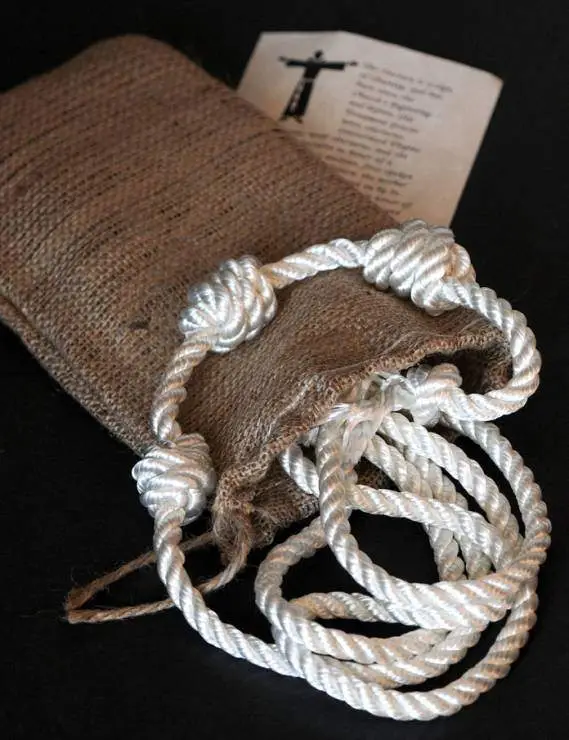
Three Knots Our Lady Helps Us Keep Tied
The cincture — often called the white cord — has long been a sign of chastity, self-discipline, and consecration. Its roots stretch deep into salvation history. Old Testament priests wore cinctures, and consecrated virgins and religious continue to wear them today. Devotion to the cincture in honor of particular saints stretches back to ancient times.
A Sign of Our Lady’s Protection
The tradition is notably connected to St. Monica, mother to St. Augustine. Tradition holds that St. Monica experienced a vision of the Blessed Virgin bestowing upon her a belt (although hers was a black leathern belt), with the assurance that all who wore this belt in honor of Our Lady would be taken under her special protection. Monica reported this vision to St. Ambrose who also adopted the practice and who reportedly girded St. Augustine with a similar belt upon his baptism.
Centuries later, the practice was carried forward by St. Dominic, who wore the cincture in honor of St. Francis of Assisi (more details on that will come shortly). Franciscans today wear a white cincture known as the Cintura Bianca — the “white rope.”
Evangelica Counsels
The three knots on the Franciscan cincture represent the three evangelical counsels: poverty, chastity, and obedience — the cornerstones of Franciscan life. These knots are not merely symbolic; they reflect real spiritual commitments that require daily grace to remain firmly tied.
This is where Our Lady’s help is essential.
Mary, who lived these virtues perfectly, strengthens us whenever our resolve weakens. She helps us keep these knots tied when the world tempts us to loosen them.
As Fra Chris Dickson, director of the Franciscan Lay Apostolate, writes:
“St. Dominic once asked St. Francis of Assisi for the white cord he wore over his tunic. Dominic wore this cord under his habit for the remainder of his life in honor of St. Francis, whom he so greatly admired and respected.”
Whether worn visibly or hidden beneath clothing, the cincture remains a quiet reminder of consecration — and of the Mother who helps us remain faithful.
What Do the Three Knots on the Franciscan Cincture Represent?
The three knots on the Franciscan cincture represent the evangelical counsels of poverty, chastity, and obedience — the foundational promises of Franciscan life. These knots are not merely decorative; they symbolize concrete spiritual commitments freely embraced for the love of Christ. Each knot reminds the friar that fidelity requires daily grace and perseverance. Through her maternal intercession, Our Lady strengthens us to keep these sacred vows firmly tied.