
Revised October 5, 2026, to clarify the meaning, biblical foundations, and reverent practice of Eucharistic processions.
What Is a Eucharistic Procession?
The Eucharistic procession is not merely a beautiful Catholic custom. It is a public proclamation that Jesus Christ is truly present in the Blessed Sacrament. From the visit of the Magi to the Way of the Cross, the history of salvation has always involved movement—a procession of souls toward the Lord.
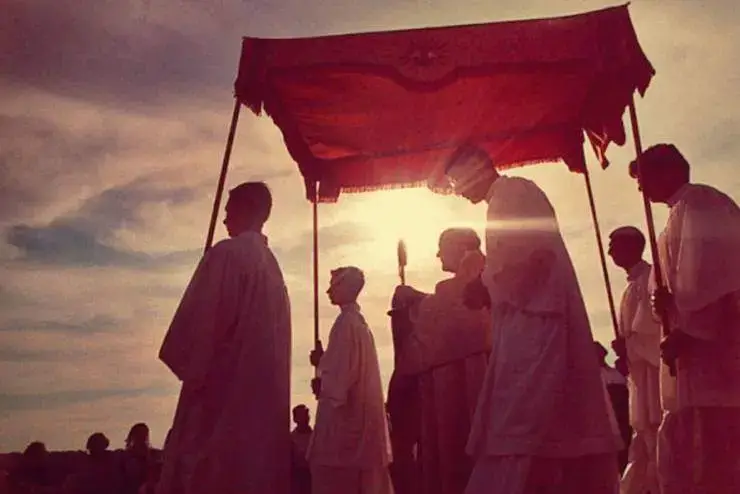
In this public act of worship, a consecrated Host is placed in a monstrance and carried reverently by a priest. The faithful walk with the Blessed Sacrament while praying and singing. On Corpus Christi, the procession normally follows Mass and concludes with Benediction.
The Church describes the Corpus Christi procession as a continuation of the Eucharistic celebration and a public profession of faith and worship. It begins at the altar and carries that worship into the streets, while always remaining connected to the Mass from which it flows.
Why Do Catholics Have Eucharistic Processions?
Catholics hold Eucharistic processions because the consecrated Host is Jesus Christ himself, truly, really, and substantially present—Body, Blood, Soul, and Divinity (CCC 1374). The faithful adore the living Christ. Carrying the Blessed Sacrament in procession is one way the Church gives him the worship that belongs to God alone (CCC 1378).
The procession also shows the Church as a pilgrim people journeying with the Lord. Catholics bring their thanksgiving, needs, sorrows, and hopes before Jesus. Neighbors who see the procession receive a quiet invitation to ask whom Catholics are following and why.
The best-known procession takes place for the Solemnity of Corpus Christi. To learn how this feast entered the Church’s calendar, read about St. Juliana of Liège. Our Corpus Christi reflection offers a prayerful way to prepare for the solemnity.
Reaching Out Like the Woman in the Gospel
In the Gospel of Mark, a woman who had suffered for twelve years pressed through the crowd and touched the cloak of Jesus. She said, “If I touch even his garments, I shall be made well” (Mark 5:28). Her faith was bold, her gesture was simple, and Jesus received her with compassion.
A Eucharistic procession invites us to approach Christ with that same trust. The comparison is spiritual: the gesture rests on faith rather than magic, and the procession remains an act of worship. As he passes, we may place before him an illness, a wounded relationship, a loved one who has left the Church, or a burden we cannot carry alone.
Are Eucharistic Processions Biblical?
Scripture gives the foundations for Eucharistic processions, even though the complete modern rite developed later. Israel carried the Ark of the Covenant with reverence, and David danced before the Lord as the Ark entered Jerusalem (2 Samuel 6:14). The Ark was a sign of God’s covenant presence; in the Eucharist, the whole Christ is sacramentally present.
Jesus also declared, “I am the living bread which came down from heaven” (John 6:51), and at the Last Supper he said of the bread, “This is my body” (Luke 22:19). The procession expresses the Church’s faith in those words. Catholics follow the Blessed Sacrament because they believe they are following Jesus.
What Happens During a Eucharistic Procession?
A Eucharistic procession ordinarily begins after Mass. The Host consecrated during that Mass is placed in a monstrance. A priest carries it, often beneath a canopy, while the people follow with hymns and prayers. Candles, incense, flower petals, and prayer stations may be included according to the Church’s norms and local custom. The procession commonly ends with Benediction of the Blessed Sacrament.
Each parish or diocese may arrange the route and details differently, so participants should follow the directions of the clergy and organizers. The essential attitude remains the same: attentive, prayerful worship of Christ. A concrete example can be seen in the account of the Knights participating in a Eucharistic procession in Lincoln.
How Should I Take Part in a Eucharistic Procession?
- Begin with Mass when it is part of the celebration. The procession flows from the Eucharistic sacrifice.
- Follow prayerfully. Join the hymns and responses, and keep your attention on Christ while limiting distractions such as photography.
- Bring an intention. Entrust a person, family need, parish, or community concern to Jesus.
- Show simple reverence. Follow local directions for kneeling, standing, and making room for the Blessed Sacrament.
- Do what your health allows. A person who cannot walk the route can still adore Christ, pray for the procession, or wait reverently along its path.
Living the Procession After It Ends
The procession does not end when Benediction concludes. Reverence at Mass should become charity at home, patience at work, fidelity in prayer, and mercy toward those who suffer. Public witness becomes credible when the people who follow Christ also serve him in their neighbors.
Continue the encounter by visiting Jesus in the tabernacle or spending time in Eucharistic adoration. Our Adoration Prayer can help you remain with him in quiet faith.
Closing Prayer
Lord Jesus Christ, truly present in the Most Holy Eucharist, draw us close to you. Receive our gratitude, our wounds, and the people we carry in our hearts. Teach us to follow you with reverence in the procession and with faithful charity each day. Amen.