
Revised October 5, 2026, drawing on Benedict XVI’s teaching on St. Juliana and the origins of Corpus Christi.
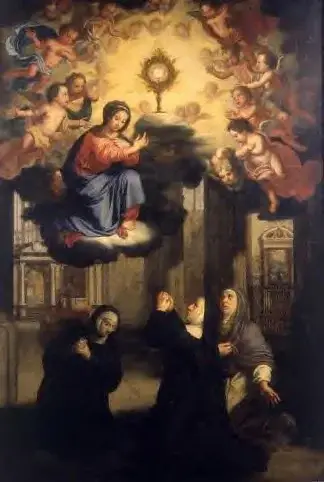
St. Juliana of Liège, also called St. Juliana of Cornillon, helped give the Church the feast of Corpus Christi. Her story shows how a quiet life of prayer before the Eucharist can bear fruit far beyond what one person could foresee.
Who was St. Juliana of Liège?
Juliana was born near Liège, in present-day Belgium, around 1191 or 1192. Orphaned when she was young, she and her sister Agnes were entrusted to the Augustinian women at Mont-Cornillon, where a religious community served a leprosarium.
Liège already had a strong Eucharistic culture. Women gathered for prayer and works of charity, theologians reflected deeply on the Blessed Sacrament, and devotion to Christ’s Real Presence was growing. In that setting Juliana learned to read Latin, studied writers such as St. Augustine and St. Bernard, and developed a deep contemplative love for Jesus in the Eucharist.
She eventually received the religious habit and later became prioress. Yet her lasting influence did not come from holding an office. It came from returning faithfully to the presence of Christ.
St. Juliana’s vision of the moon
Beginning when she was about sixteen, Juliana repeatedly saw a vision during prayer: a bright full moon marked by a dark band. After patiently seeking its meaning, she understood the moon as an image of the Church’s liturgical life and the dark line as the absence of a feast dedicated especially to the Body and Blood of Christ.
Juliana did not immediately announce the vision. She kept it quietly for many years, testing it through prayer. Eventually she shared it with other faithful women, including Blessed Eve of Liège, and sought guidance from trusted clergy.
Benedict XVI praised this pattern of discernment in his 2010 audience on St. Juliana of Cornillon: prayer, patience, friendship with good souls, and submission to the judgment of the Church. Juliana’s experience was private revelation; it did not create doctrine. It helped the Church celebrate more fully a truth already received from Christ.
How St. Juliana helped inspire Corpus Christi
Juliana and her companions asked the Church for a feast in which Catholics could honor the Eucharist with particular solemnity, grow in faith, and make reparation for offenses against the Blessed Sacrament. Robert de Thourotte, Bishop of Liège, approved a local celebration in 1246.
Juliana also knew Jacques Pantaléon, who later became Pope Urban IV. In 1264 he established the solemnity of Corpus Christi for the universal Church. St. Thomas Aquinas composed the liturgical texts associated with the feast, giving Catholics enduring hymns such as the Pange Lingua and Adoro Te Devote.
The feast developed over time, but Juliana’s faithful persistence helped prepare the way. She did not live to see its full spread throughout the Church. She died in 1258 after years marked by opposition, displacement, and continued devotion to the Eucharist.
What St. Juliana teaches us about adoration
The Church teaches that Jesus Christ is truly, really, and substantially present in the Eucharist—Body, Blood, Soul, and Divinity (CCC 1374). Juliana did not treat that truth as an abstract lesson. She lived before the Eucharistic Lord as before a beloved Person.
Anyone who keeps a regular hour of adoration learns the same lesson. Some hours feel full of consolation; others are quiet, distracted, or difficult. The value of the hour does not depend on what we feel. We remain because Jesus remains, and over time his presence teaches the heart to listen, persevere, and love.
That hidden prayer is the heart of the vocation of the Knights of the Holy Eucharist, Franciscan brothers devoted to Eucharistic adoration. Juliana shows that it can become a gift for the whole Church.
When is St. Juliana’s feast day?
St. Juliana of Liège is remembered on April 6, the day of her death in 1258. The feast she helped bring about, Corpus Christi, falls on the Thursday after Trinity Sunday; in the United States it is celebrated on the following Sunday.
Living St. Juliana’s Eucharistic devotion
- Visit Jesus in the tabernacle. Even a brief visit offered with love is worthwhile.
- Prepare carefully for Sunday Mass. Arrive early enough to become quiet before the Lord.
- Make a Holy Hour when possible. Bring Scripture, pray slowly, and leave room for silence.
- Take part in Corpus Christi. Attend Mass and, where available, join the Eucharistic procession.
- Pray with patience. If God places a good desire in your heart, test it humbly and let it mature.
For a reflection on prayer during this solemnity, read our article Corpus Christi: A Call to Simple, Loving Prayer from the Heart. You may also use our Adoration Prayer during your next visit to the Blessed Sacrament.
A prayer with St. Juliana
Lord Jesus Christ, truly present in the Most Holy Eucharist, give us the faithful love of St. Juliana of Liège. Teach us to seek You in silence, to remain with You in difficulty, and to lead others gently toward Your presence. May our worship at Mass and in adoration deepen our faith, strengthen our charity, and console Your Sacred Heart. Amen.