
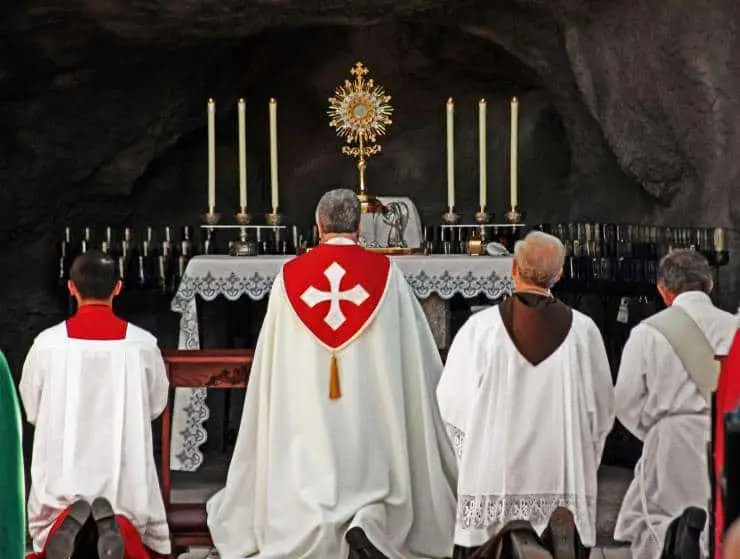
What Does “Venite Adoremus” Mean?
Venite adoremus is Latin for “O come, let us adore” — traditionally completed as venite adoremus Dominum, “O come, let us adore the Lord.” Most Catholics know the phrase best as the refrain of the beloved Christmas hymn “Adeste Fideles” (“O Come, All Ye Faithful”), sung after every verse: “Venite adoremus, venite adoremus, venite adoremus Dominum.” The same invitation opens the Invitatory Psalm (95) that begins the Church’s daily prayer: “O come, let us sing joyfully to the Lord… let us come into His presence with thanksgiving.” Both point to the same act: coming before God to adore Him — the very invitation Catholics accept each time they enter a church where Christ is truly present in the tabernacle.
Why Catholics Genuflect Before the Tabernacle
From 96 year old Monsignor Foy…
“I was recently contacted with concerns that some clergy and laity need to be reminded that they should genuflect when they pass by the Tabernacle. In response, I am posting the following sources in support of the reception of Holy Communion on the tongue, kneeling, genuflecting, the restoration of Communion rails, centrally-placed Tabernacles and having the priest celebrant face the Tabernacle and worship God with the people at Mass. These have been longtime traditions of the Roman Rite of the Catholic Church.
Kneeling “officially signifies adoration” (Ceremonial of Bishops, Nos. 68-72 p.36-37).
“One waits for symbols and promises standing, but the Reality, one receives with love and on one’s knees” (Pope Saint Pius X).
“The Catholic Church has always offered and still offers the worship of latria [adoration] to the Sacrament of Eucharist” (Pope Paul VI, Mysterium Fidei, 1965, n.56).
“No one eats of this flesh without having first adored it and not only do we not sin by adoring but we would sin by not adoring” (Ibid., n.55, St. Augustine, In Ts, Ch.98, 9:PL 37, 126).”
Eucharistic adoration and genuflection express belief in the Real Presence of Jesus Christ. When the Blessed Sacrament is reserved in the tabernacle, a genuflection is a bodily act of worship directed to Christ, not merely a gesture toward a church furnishing. Done attentively, this simple practice helps unite outward reverence with interior faith and reminds Catholics that the Lord they receive at Mass remains truly present.
An Invitation to Adore
“Venite adoremus” is more than a line from a carol — it is an invitation renewed every time the Blessed Sacrament is exposed or reserved in the tabernacle. To genuflect before the tabernacle, or to kneel in adoration before the monstrance, is to answer that invitation with the whole body, not just the lips: Come, let us adore Him.