
Originally published December 10, 2017; substantially revised October 5, 2026.
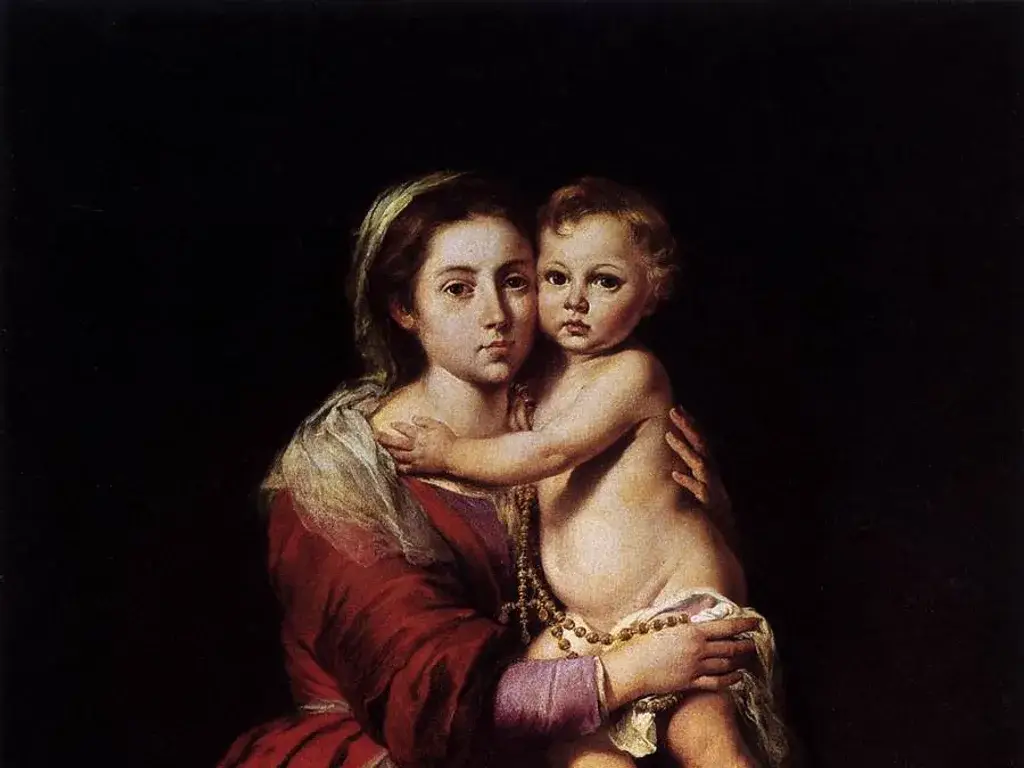
The image of the Rosary as a ladder to heaven expresses a simple Catholic truth: Mary does not keep us for herself. She places Jesus before us and teaches us to contemplate his life, trust his promises, and follow him faithfully.
Christ alone is our Savior and the one mediator who reconciles humanity to the Father. The Rosary does not go around him; it is a deeply Christ-centered prayer that lets us walk through the Gospel in the company of his Mother.
Why Call the Rosary a Ladder to Heaven?
In the ancient Akathist Hymn, Mary is praised as the heavenly ladder by which God came down. The image recalls the mystery of the Incarnation: the eternal Son truly became man through Mary’s free and faithful consent.
When we speak of the Rosary as a ladder, we do not mean that we climb to heaven by our own efforts or by repeating a certain number of prayers. Salvation is God’s grace. The image describes a journey of contemplation: mystery by mystery, Mary helps us look toward Christ and receive the Gospel more deeply.
Why Do Catholics Pray the Rosary?
The Rosary places the principal mysteries of Jesus’ life before the mind and heart. In the joyful mysteries we contemplate his Incarnation and hidden life. The luminous mysteries lead us through his public ministry. The sorrowful mysteries remain with him in his Passion. The glorious mysteries proclaim his Resurrection, the gift of the Holy Spirit, and the destiny prepared for those who belong to him.
St. John Paul II described the Rosary as a prayer with a clearly Christological character. His apostolic letter Rosarium Virginis Mariae explains that contemplating Christ with Mary helps the face of Jesus become more familiar to us.
Is the Rosary About Mary or Jesus?
The words of the Hail Mary are Marian, but the heart of the prayer is Jesus. His name stands at the center of every Hail Mary, and each decade asks us to contemplate a mystery of his saving life.
Mary’s role is always maternal and Christ-centered. At Cana she says, “Do whatever he tells you” (John 2:5). The Rosary carries the same message. Authentic devotion to Mary never ends with Mary; it forms disciples who listen to her Son.
The Church honors Mary because God honored her with a unique place in the mystery of Christ. This devotion differs entirely from the adoration owed to God alone (CCC 971).
What Should We Think About During the Rosary?
Announce the mystery and place yourself within the Gospel scene. Consider what Jesus is doing, what the mystery reveals about his love, and how he is inviting you to respond.
The vocal prayers create a gentle rhythm while the heart remains with Christ. We need not force a detailed mental picture. Sometimes a single word, virtue, or moment is enough: Mary’s trust at the Annunciation, Christ’s mercy in his ministry, his surrender in Gethsemane, or the joy of the Resurrection.
If you need the complete order of prayers and mysteries, use our dedicated guide explaining how to pray the Rosary. This article keeps a different purpose: understanding why the Rosary draws us toward Jesus.
What If I Become Distracted While Praying?
Distraction does not make the prayer worthless. When the mind wanders, return gently to the mystery, the name of Jesus, or the words being prayed. This quiet return can itself become an act of love.
What God asks is faithful presence rather than flawless concentration. A Rosary prayed tiredly, with repeated efforts to return to Christ, may be more loving than a prayer that feels effortless.
Begin with One Decade
Someone who finds five decades difficult can begin with one. Announce the mystery, pray the Our Father, ten Hail Marys, and the Glory Be, and spend a little time contemplating Jesus.
As the prayer becomes more familiar, add another decade or pray a complete set of mysteries. St. Louis de Montfort’s method of praying the Rosary offers another traditional way to deepen attention without rushing.
Is the Rosary in the Bible?
The string of beads is not described in Scripture, but most of what we say and contemplate on it comes straight from the Bible. The Our Father is the prayer Jesus himself taught (Matthew 6:9–13). The first half of the Hail Mary joins the angel Gabriel’s greeting (Luke 1:28) to Elizabeth’s words to Mary (Luke 1:42); the second half asks for her prayers. Almost every mystery is a Gospel scene, from the Annunciation to Pentecost. The last two glorious mysteries, Mary’s Assumption and Coronation, come from the Church’s tradition and teaching.
That is why the Rosary is often called a summary of the Gospel. Praying it well is a way of praying with Scripture.
Who Started the Rosary?
The Rosary grew over several centuries. Medieval Christians who could not pray all 150 Psalms began praying 150 Our Fathers or Hail Marys instead, counted on knotted cords or beads. Tradition associates the Rosary especially with St. Dominic in the thirteenth century. Pope St. Pius V gave it its classic form in 1569, and St. John Paul II added the five Luminous Mysteries in 2002.
Living the Mysteries You Pray
- Ask for Mary’s trust when God’s plans are unclear.
- Carry Christ’s mercy into one difficult relationship.
- Offer a sorrow or sacrifice with Jesus rather than carrying it alone.
- Let the Resurrection renew hope in a place of discouragement.
- Pray one decade for someone who has asked for your prayers.
A Prayer Before the Rosary
Lord Jesus Christ, as I pray the Rosary, keep my heart close to you. Through the loving help of your Mother, teach me to contemplate your life, receive your mercy, and follow you faithfully. When I am distracted, call me back gently. May every mystery deepen my faith, strengthen my hope, and make my life more generous in love. Amen.
If this prayer is awakening a desire to belong more completely to Christ, you may explore discerning a vocation with the Knights of the Holy Eucharist.