
O Jesus, I surrender myself to You, take care of everything!
Pray these words ten times each day. The complete nine-day novena begins below.
The Surrender Novena is a nine-day Catholic prayer of trust and abandonment associated with the Servant of God Fr. Dolindo Ruotolo, a twentieth-century priest from Naples, Italy.
At the heart of the novena is a remarkably simple prayer:
“O Jesus, I surrender myself to You, take care of everything!”
Repeated ten times each day, these words express the central lesson of the Surrender Novena: after bringing our needs to Jesus, we are invited to entrust them to Him rather than allowing fear, worry, and our desire to control the outcome to overwhelm us.
The novena is especially meaningful when facing circumstances we cannot resolve ourselves—a serious illness, family difficulty, financial problem, uncertain future, important decision, or any situation in which we need to place ourselves more completely in the hands of God.
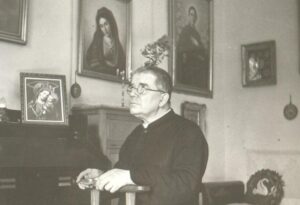
Servant of God Fr. Dolindo Ruotolo (1882–1970), the Neapolitan priest associated with the Surrender Novena and the prayer, “Jesus, You take care of it.”
The Surrender Novena is prayed over nine consecutive days.
Each day, begin with the Sign of the Cross and take a few moments to place yourself quietly in the presence of God.
Bring to Jesus the intention that is weighing upon your heart. Tell Him plainly what you need, what you fear, and what you cannot resolve on your own.
Then read the meditation for that day slowly.
After the meditation, pray ten times:
O Jesus, I surrender myself to You, take care of everything!
Do not rush through the words. The repetition is an opportunity to surrender the same concern again and again whenever your mind tries to take it back.
Conclude by entrusting yourself to the Blessed Virgin Mary and making the Sign of the Cross.
The first day begins with the relationship between worry and surrender.
We often pray about a problem while simultaneously trying to control every possible outcome. Our thoughts circle around the difficulty: What if this happens? What if that happens? What am I going to do?
True surrender asks us to place the matter into the hands of Jesus.
This does not mean that we stop fulfilling our responsibilities. Rather, after doing what God reasonably asks of us, we stop acting as though everything ultimately depends upon us.
Today, place your intention before Jesus and ask for the grace to release your anxious grasp upon it.
Then pray ten times:
O Jesus, I surrender myself to You, take care of everything!
On the second day, meditate upon the difference between surrender and resignation.
Christian surrender is not hopelessness. It does not mean saying, “Nothing can be done.”
Surrender is an act of confidence.
Think of a child who brings a problem to a loving parent. Having asked for help, the child does not need to dictate every step the parent must take.
We often do exactly that with God.
We ask Him to help us and then immediately begin telling Him how the problem must be solved.
Today, ask for the grace to trust not only that God hears your prayer, but that His wisdom exceeds your own.
Then pray ten times:
O Jesus, I surrender myself to You, take care of everything!
The third day turns our attention toward the prayer Jesus Himself taught us:
“Thy will be done.”
These words can be difficult when God’s will is not yet clear to us.
They are not meant to be spoken as a defeated sigh. They are words of profound confidence in a Father who sees what we cannot see.
We may ask God boldly for healing, reconciliation, employment, protection, guidance, or any other good thing. But beneath every petition remains the deeper prayer:
Father, I trust Your will.
Today, surrender not only the problem but also the outcome you have imagined for it.
Then pray ten times:
O Jesus, I surrender myself to You, take care of everything!
Sometimes we surrender something to God and the situation appears to become worse.
That is when surrender becomes particularly difficult.
We may begin wondering whether God heard us at all.
The fourth day invites us to trust Jesus even when we cannot yet understand what He is doing.
Faith does not require us to pretend that suffering is easy. Nor does it prohibit us from seeking appropriate help. Rather, faith keeps us from concluding that God has abandoned us simply because we cannot presently see the answer.
Today, surrender the temptation to judge God’s goodness according to what you can see at this moment.
Then pray ten times:
O Jesus, I surrender myself to You, take care of everything!
The fifth day invites us toward the childlike trust praised throughout the Gospel.
A small child can fall asleep while being carried because the child trusts the one doing the carrying.
There are moments in our lives when we cannot see the road ahead.
We do not know what tomorrow will bring. We cannot determine how a problem will be resolved. We may not even know what to ask for anymore.
At such times, surrender becomes very simple:
Jesus, carry me.
Today, allow yourself to rest spiritually in the care of Christ.
Then pray ten times:
O Jesus, I surrender myself to You, take care of everything!
The sixth day concerns the restlessness that returns after we surrender.
Perhaps yesterday we entrusted everything to Jesus and experienced peace. Today the worry has returned.
That does not mean the prayer failed.
Surrender is often something we must practice repeatedly.
Each time fear returns, it gives us another opportunity to place the matter back into God’s hands.
We can say:
Jesus, I gave this to You yesterday. I give it to You again today.
Then pray ten times:
O Jesus, I surrender myself to You, take care of everything!
The seventh day asks us to examine how much we rely upon our own calculations.
Human reason is a gift from God. Prudence, planning, medical treatment, good counsel, and responsible action all have their proper place in Christian life.
But reason cannot see everything.
There eventually comes a point beyond which planning cannot carry us.
Surrender begins precisely there.
After we have done what is ours to do, we entrust what remains to Divine Providence.
Today, ask Jesus for the humility to recognize the difference between what He asks you to do and what you must leave to Him.
Then pray ten times:
O Jesus, I surrender myself to You, take care of everything!
The eighth day focuses upon fear of the future.
Much of our anxiety concerns things that have not happened.
We imagine tomorrow’s conversations, tomorrow’s diagnosis, tomorrow’s bills, tomorrow’s disappointments, and tomorrow’s losses.
But God’s grace is given to us in the present.
Jesus asks us to live faithfully today and entrust tomorrow to Him.
When your mind begins constructing frightening possibilities, return to this simple act of surrender.
Then pray ten times:
O Jesus, I surrender myself to You, take care of everything!
On the final day, gather together everything you have placed before Jesus during the novena.
Perhaps nothing outwardly has changed.
Perhaps everything has changed.
Either way, the deepest purpose of the Surrender Novena is not to discover a technique for getting God to give us the outcome we want.
It is to change our relationship with Him.
The goal is greater trust.
Place your intention before Jesus once more. Thank Him for hearing you, even if you do not yet know the answer.
Ask for the grace to continue surrendering after the novena ends.
Then pray ten times:
O Jesus, I surrender myself to You, take care of everything!
Fr. Dolindo Ruotolo was born in Naples, Italy, on October 6, 1882, into a large family that experienced serious financial hardship and family difficulties.
From an early age he desired to become a priest. After entering the Apostolic School of the Priests of the Mission, he pursued his vocation and was ordained in June 1905.
His priestly life would be marked by extraordinary suffering.
Following accusations concerning his teaching, Fr. Dolindo underwent lengthy scrutiny by Church authorities. On March 4, 1921, he was suspended a divinis and was unable to exercise his priestly ministry until his faculties were restored in July 1937.
During those painful years, he remained obedient to the Church.
After being restored to priestly ministry, Fr. Dolindo devoted himself intensely to preaching, hearing Confessions, and spiritual direction. From 1942, he assisted his brother, Fr. Elio, at the Church of San Giuseppe dei Vecchi in Naples.
He was also a prolific writer. His work included an extensive commentary on Sacred Scripture.
In November 1960, Fr. Dolindo suffered a stroke that paralyzed the left side of his body. Despite his poor physical condition and considerable suffering, he resumed his apostolate and continued it for another ten years.
Fr. Dolindo died in Naples on November 19, 1970, at the age of eighty-eight. His remains are now in the Church of San Giuseppe dei Vecchi, where he had served for many years. His cause for canonization has been opened, and he is known as Servant of God Dolindo Ruotolo. His official biography documents both his 1937 restoration to ministry and his continued apostolate following the 1960 stroke.
The Italian expression closely associated with Fr. Dolindo is:
Gesù, pensaci Tu.
It can be rendered in English as:
Jesus, You take care of it.
Those few words summarize an entire spirituality.
They do not mean:
Jesus, I refuse to do anything.
They mean:
Jesus, I will do what You ask of me, but I refuse to pretend that I am God. What lies beyond my ability I place into Your hands.
That distinction is essential.
A sick person who surrenders to Jesus can still seek medical treatment.
A person seeking employment can still submit applications.
A family experiencing difficulty can still seek counsel and work toward reconciliation.
Surrender does not replace responsible action. It frees us from the illusion that our peace depends upon controlling everything.
The spirituality expressed in the Surrender Novena belongs to a much older Catholic tradition of abandonment to Divine Providence.
Jesus teaches:
“Thy will be done.”
At Gethsemane, facing His Passion, Christ entrusts Himself completely to the Father’s will.
Christian surrender follows His example.
It means trusting that Divine Providence remains active even when circumstances are painful or confusing.
This is also why surrender cannot be reduced to obtaining miracles.
Sometimes God’s providence changes the circumstances.
Sometimes He gives us the strength to pass through circumstances we would never have chosen.
The prayer remains:
Jesus, I trust You. Jesus, You take care of it.
Fr. Dolindo lived during the same period as St. Padre Pio of Pietrelcina, and the two priests are connected in Catholic devotional history.
A documented meeting between Padre Pio and Fr. Dolindo took place at San Giovanni Rotondo in 1953, and traditions surrounding the two men attest to Padre Pio’s high regard for the Neapolitan priest.
Both men’s spirituality emphasized trust in God amid suffering, prayer, the Sacraments, and abandonment to Divine Providence.
If you are carrying a particular illness or praying for someone who is sick, you may also wish to pray our Padre Pio Prayer for Healing.
Fr. Dolindo’s spirituality also has a striking kinship with another modern Catholic prayer of trust: the Prayer of Abandonment associated with Saint Charles de Foucauld.
Both spiritualities ask the Christian to place his or her entire life into the Father’s hands.
Surrender is therefore not merely something we practice during emergencies.
It can become a way of living.
Morning by morning, we can place our plans before God:
Father, guide me.
When plans change:
Jesus, I trust You.
When something is beyond our control:
Jesus, You take care of it.
You can also pray our Prayer of Abandonment as another way of deepening this trust in Divine Providence.
This question deserves a careful answer.
The Surrender Novena is a private devotional prayer, not part of the Church’s liturgy. Fr. Dolindo Ruotolo has not been canonized; his cause is underway and he bears the title Servant of God.
The novena is nevertheless prayed and promoted in Catholic settings, including diocesan resources. For example, the Catholic Diocese of Pittsburgh provides the Surrender Novena as a prayer resource and identifies its repeated daily invocation as “O Jesus, I surrender myself to you, take care of everything!”
The important distinction is that Catholics are not required to practice private devotions such as this novena.
Its spirituality should lead us more deeply into the ordinary life of Catholic faith: trust in God, prayer, Sacred Scripture, the Holy Eucharist, Confession, charity, and faithful acceptance of God’s will.
You can pray the Surrender Novena whenever you need greater trust in God.
It can be especially helpful during:
serious illness or an uncertain diagnosis; family problems or a troubled relationship; financial difficulties; anxiety about the future; discernment about an important decision; concern for a child or loved one; grief and loss; employment difficulties; or any circumstance that seems beyond your ability to resolve.
There is no need to wait for a particular feast day.
The deeper intention is always the same:
Jesus, I place this in Your hands.
Yes.
You may offer the novena for yourself or for another person.
At the beginning of each day’s prayer, simply bring that person and intention before Jesus.
For example:
Lord Jesus, I offer this Surrender Novena for [name]. I place this person and this need completely into Your hands. Give us the grace to trust Your wisdom, Your mercy, and Your providence.
Then continue with that day’s meditation and the repeated prayer of surrender.
This may be the most important question of all.
Surrender does not mean that God promises to give us everything we request in precisely the form we request it.
Christian prayer is not a transaction.
We ask confidently because Jesus tells us to ask. But we also trust that God sees infinitely more than we do.
Sometimes we recognize the answer quickly.
Sometimes the answer comes differently than we expected.
Sometimes we must continue trusting while carrying a cross whose purpose we cannot understand.
That is precisely where surrender becomes more than a beautiful idea.
It becomes faith.
The Surrender Novena is a nine-day Catholic devotion associated with Servant of God Fr. Dolindo Ruotolo. Its central theme is complete trust in Jesus and abandonment to Divine Providence.
The Surrender Novena is associated with the spiritual writings of Fr. Dolindo Ruotolo, a Neapolitan Catholic priest who lived from 1882 to 1970.
The best-known prayer is:
“O Jesus, I surrender myself to You, take care of everything!”
It is traditionally repeated ten times each day of the novena. The Diocese of Pittsburgh’s published version likewise directs the faithful to repeat the invocation ten times after each day’s reflection.
The Surrender Novena is prayed for nine days, as the word novena indicates.
The Italian phrase means essentially “Jesus, You take care of it.” It expresses confidence that after doing what God asks of us, we can entrust what remains beyond our control to Him.
Yes. The Surrender Novena does not need to begin on a particular date. You can begin whenever you wish to entrust a need to Jesus or grow in trust in Divine Providence.
No. Unlike a Rosary or certain chaplets, the Surrender Novena does not require special beads. You may simply count the ten repetitions of the surrender prayer on your fingers or use Rosary beads if they help you keep track.
Lord Jesus Christ,
I place into Your hands everything I cannot control.
I give You my worries about the future, my unanswered questions, my fears, my plans, my disappointments, and the intentions I carry silently within my heart.
Give me wisdom to recognize what You ask me to do and courage to do it faithfully.
Give me humility to recognize what I cannot do and trust enough to leave it with You.
When fear returns, remind me that You are near.
When I begin trying to control what belongs to Your Providence, teach me again to surrender.
When Your answer differs from the answer I hoped for, keep me close to You.
Bless my family and those I love. Guide those who care for the sick. Strengthen those who suffer. Console those who grieve. Provide for those who are in need.
Blessed Virgin Mary, teach me to say with you:
“Be it done unto me according to thy word.”
And Jesus, whatever today may bring, give me the grace to pray with confidence:
O Jesus, I surrender myself to You, take care of everything!
Jesus, I trust in You.
Amen.
Share this prayer