
The St. Rita prayer asks her intercession when suffering or a difficult situation feels overwhelming. Bring your need to God with confidence and patience.
O glorious St. Rita, thou who didst miraculously share in the sorrowful Passion of our Lord Jesus Christ, obtain for me that I may bear with resignation the sufferings of this life, and protect me in all my necessities.
Traditional prayer from the 1910 Raccolta, no. 392.
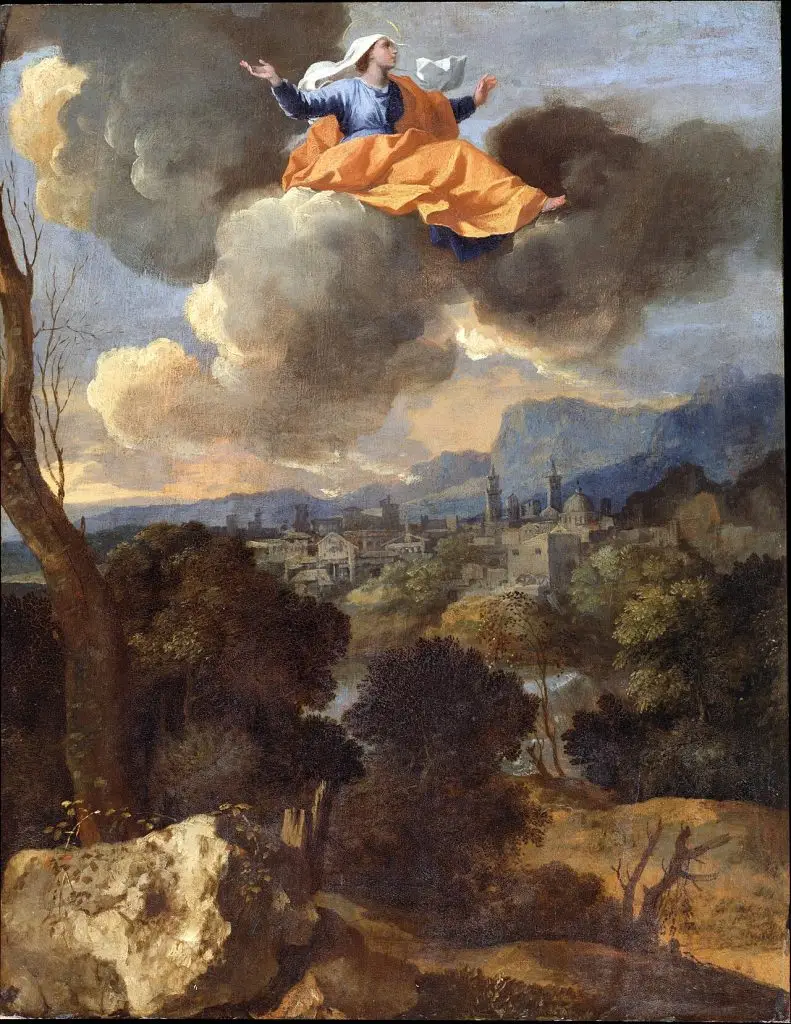
Nicolas Poussin, The Translation of Saint Rita of Cascia, Dulwich Picture Gallery. Public domain. Image source
Pray this whenever you need perseverance or help in a difficult situation. To make a simple novena, pray it once a day for nine consecutive days, naming your intention before or afterward. St. Rita’s feast is May 22; a novena preparing for the feast may be prayed May 13–21. You may also add the Our Father, Hail Mary, and Glory Be, without treating the number of prayers as a guarantee of an outcome.
St. Rita is widely invoked in difficult and seemingly impossible situations. Her life as a wife, mother, widow, and Augustinian nun makes her a companion in many kinds of sorrow. EWTN’s account of her life explains the devotion that grew around her witness. Asking her intercession means asking her to pray to God with us.
You can pray the traditional prayer above for nine days with one intention. Set aside a time you can realistically keep, perhaps before work or after your evening prayer. Tell God plainly what troubles you, then ask for the grace to act faithfully today. If you miss a day, resume prayer without fear that you have invalidated your petition.
No devotional prayer guarantees a particular miracle or deadline. We may ask boldly for help while trusting God with the answer. The word “resignation” in this traditional prayer means entrusting suffering to God; it does not require remaining in danger or accepting abuse. Seek appropriate help and protection when a situation is unsafe.
St. Rita was born at Roccaporena, near Cascia, in 1386 and died at the Augustinian convent of Cascia in 1456. She had wanted to enter religious life, but obeyed her elderly parents and married. Her husband was harsh and ill-tempered, and after eighteen years he was murdered. Rita prayed that her twin sons would not avenge him, and both died reconciled to God.
Widowed and bereaved, she asked to enter the Augustinian convent at Cascia and was refused. She was admitted only after persistent entreaty, received the habit, and was professed. So many favours were reported through her intercession that in Spain she came to be called La Santa de los impossibles, the saint of impossible things. Pope Urban VIII permitted her Mass and Office in 1637, and she was canonised on 24 May 1900. Her feast is kept on 22 May.
An impossible case is simply a situation that will not move. People bring St. Rita a marriage that seems past repair, a son or daughter who has left the faith, an illness with no good prognosis, work that has run out. What these have in common is that the person praying has no plan of their own left.
Rita is asked because of her own life. She did not get the outcome she first wanted: she was not spared the marriage, the cruelty, or the loss of her husband and both sons. What she was given was the grace to keep choosing peace over revenge, and in time what she had asked for long before. To pray for an impossible cause is to ask God for the outcome, and for that same grace in the meantime.
St. Rita is usually shown with a wound on her forehead. While she was praying before a crucifix and meditating on the Passion, she struck her forehead against the crown of thorns. The injury became a painful and disfiguring ulcer, and for years afterwards she made her devotions alone because of it. She accepted it as a penance and as a share in the suffering she had been contemplating. In art she is recognised by that wound, along with roses and figs.
Share this prayer