
Originally published December 7, 2017; substantially revised October 1, 2026.
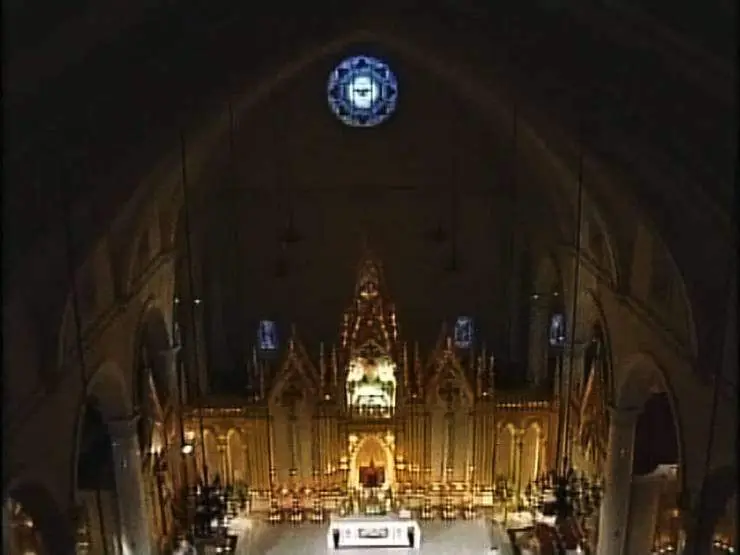
A Rorate Mass is traditionally a votive Mass of the Blessed Virgin Mary celebrated during Advent, often before sunrise in a church illuminated principally by candles. As daylight gradually fills the church, the faithful are reminded that Mary carried Jesus Christ—the Light of the World—into a world darkened by sin.
The Rorate Mass brings together some of Advent’s most beautiful themes: waiting, silence, Marian devotion, prophecy, light, and the Eucharistic presence of Christ.
What Does Rorate Caeli Mean?
The name comes from the opening words of the traditional Introit:
Rorate caeli desuper, et nubes pluant iustum.
A customary English translation is:
“Drop down dew, O heavens, from above, and let the clouds rain down the Just One.”
These words are drawn from Isaiah 45:8, a prophetic passage expressing Israel’s longing for salvation. The imagery of heaven sending down the Just One came to be understood by Christians in relation to the coming of Christ.
The verse continues by asking that the earth open and bring forth salvation. During Advent, the Church hears this longing in light of the Incarnation: the eternal Son of God took flesh in the womb of the Blessed Virgin Mary and entered human history as our Savior.
What Is a Rorate Mass?
The Rorate Mass is a Marian Advent devotion centered upon the Holy Sacrifice of the Mass. It is traditionally celebrated before dawn, with the church illuminated by candles rather than ordinary electric lighting.
Its distinguishing elements commonly include:
- Celebration during Advent
- An early hour before sunrise
- Candlelight throughout the church
- Liturgical texts honoring the Blessed Virgin Mary
- Sacred silence, chant, or traditional Advent music
- The gradual appearance of natural daylight
An Adoremus review of the Rorate Mass’s history and current practice traces related liturgical evidence to the eighth century and explains that the current Roman Missal still provides an Advent votive Mass of the Blessed Virgin Mary whose entrance antiphon begins Rorate, caeli. The National Shrine of Our Lady of Champion notes that the devotion became especially popular in German-speaking regions, where it was sometimes celebrated on several Advent mornings.
The exact form can vary. In the older Roman liturgy, the Rorate Mass has its own traditional texts and customs. In celebrations according to the current Roman Missal, a parish may use an appropriate Marian Mass when the liturgical calendar permits.
Candlelight is a cherished custom, not an essential requirement for the validity of the Mass. Likewise, details involving the Gloria, chant, vestment color, or the point at which lights are used can differ according to the liturgical form and local celebration.
Why Is the Rorate Mass Celebrated Before Dawn?
The movement from darkness into daylight makes Advent’s spiritual meaning visible.
At the beginning of Mass, the church is dark except for candlelight. As the liturgy continues, dawn begins to appear. By the time the faithful approach the altar to receive Our Lord in Holy Communion, natural light may be entering the church.
This transition symbolizes several related truths:
- Humanity waited in darkness for the promised Messiah.
- Mary awaited the birth of the Son she carried.
- Christ entered the world as its true Light.
- The Church continues to await Christ’s return in glory.
- Every Christian is called to carry Christ’s light into the world.
The Rorate Mass does not simply recreate a beautiful historical custom. It helps the faithful experience the watchfulness to which every Christian is called during Advent.
Why Does the Rorate Mass Honor Mary?
Advent is centered upon Jesus Christ, but Mary occupies a unique place within it because she awaited His birth more intimately than anyone else.
She received the message of the Archangel Gabriel, gave her faithful consent to God’s will, and carried the Savior beneath her heart. Her entire life became an Advent of loving expectation.
The Rorate Mass therefore honors Mary without separating her from her Son. Marian devotion always leads us to Jesus. Mary is not the source of the light; she is the faithful mother through whom the Light entered the world.
The candles used during the Mass recall this mystery. Each small flame points beyond itself to Christ, whom Saint John calls “the true light that enlightens every man” (John 1:9, RSV-2CE).
A Eucharistic Encounter During Advent
The deepest meaning of the Rorate Mass is found upon the altar.
Advent looks toward Bethlehem, but the Jesus whom Mary carried is not merely remembered as a figure from the past. At Mass, Christ becomes truly present—Body, Blood, Soul, and Divinity—under the appearances of bread and wine.
The faithful wait for dawn while encountering the Lord who has already come among them sacramentally.
This is why the Rorate Mass is more than candlelight, atmosphere, or music. Its beauty serves the Eucharistic mystery. The silence and darkness help us turn our attention toward Jesus, truly present in the Holy Eucharist.
Readers who would like to learn more can visit our introduction to the Holy Eucharist.
How to Prepare for a Rorate Mass
If a parish near you offers a Rorate Mass, these simple preparations may help:
- Confirm the starting time and arrive early.
- Dress warmly if traveling before sunrise.
- Bring a small candle only if the parish requests it.
- Enter the church quietly and allow the darkness to foster prayer.
- Read Isaiah 45:8 before Mass.
- Ask Mary to help you receive Jesus with her faith and love.
- Remain briefly after Mass in thanksgiving.
The Mass may be celebrated in Latin or in the local language, depending on the parish and liturgical form. Visitors should not be anxious about unfamiliar customs. Prayerful attention and reverent participation are enough.
What If There Is No Rorate Mass Near Me?
A Rorate Mass is a beautiful Advent devotion, but it is not obligatory. Catholics who cannot attend one can still embrace its spiritual meaning.
Consider:
- Attending an ordinary weekday Mass during Advent
- Praying before sunrise
- Spending time in Eucharistic adoration
- Praying the Angelus
- Reading Isaiah’s Advent prophecies
- Limiting noise and unnecessary distractions
- Lighting an Advent candle during family prayer
- Praying our Advent Prayer
The purpose is not to reproduce the appearance of a Rorate Mass at home. It is to cultivate its interior disposition: silence, attentiveness, Marian faith, and longing for Christ.
Waiting with Mary for the Light of Christ
The Rorate Mass teaches us to wait without losing hope. Darkness does not have the final word. Quietly and almost imperceptibly, the light approaches.
Mary shows us how to wait: with faith, humility, and complete openness to God’s will. When we imitate her, Advent becomes more than a countdown to Christmas. It becomes a season of conversion in which the heart makes room for Christ.
Our vocation as Franciscan brothers is centered upon the Eucharistic Lord whom Mary bore and adored. Young men discerning a life of prayer and service may learn more about the Franciscan Brothers devoted to Eucharistic adoration.
May the Blessed Virgin Mary teach us to await her Son faithfully, and may Christ’s light dispel every darkness within us.
Frequently Asked Questions
Is a Rorate Mass always celebrated in Latin?
No. It may be celebrated in Latin or in the local language, depending upon the liturgical form and parish.
Is a Rorate Mass required during Advent?
No. It is a traditional Advent devotion rather than an obligation.
Is every candlelit Advent Mass a Rorate Mass?
Not necessarily. Candlelight is characteristic of the devotion, but the Rorate Mass is specifically associated with a Marian votive Mass during Advent.
When is a Rorate Mass celebrated?
It is normally celebrated during Advent before sunrise. Some communities observe it on a Saturday, while others celebrate it on another permitted Advent weekday.