The Chaplet of the Holy Face of Jesus is prayed on six large and thirty-three small beads in reparation for blasphemy and the neglect of Sunday. Pray it step by step below, or download the free PDF.
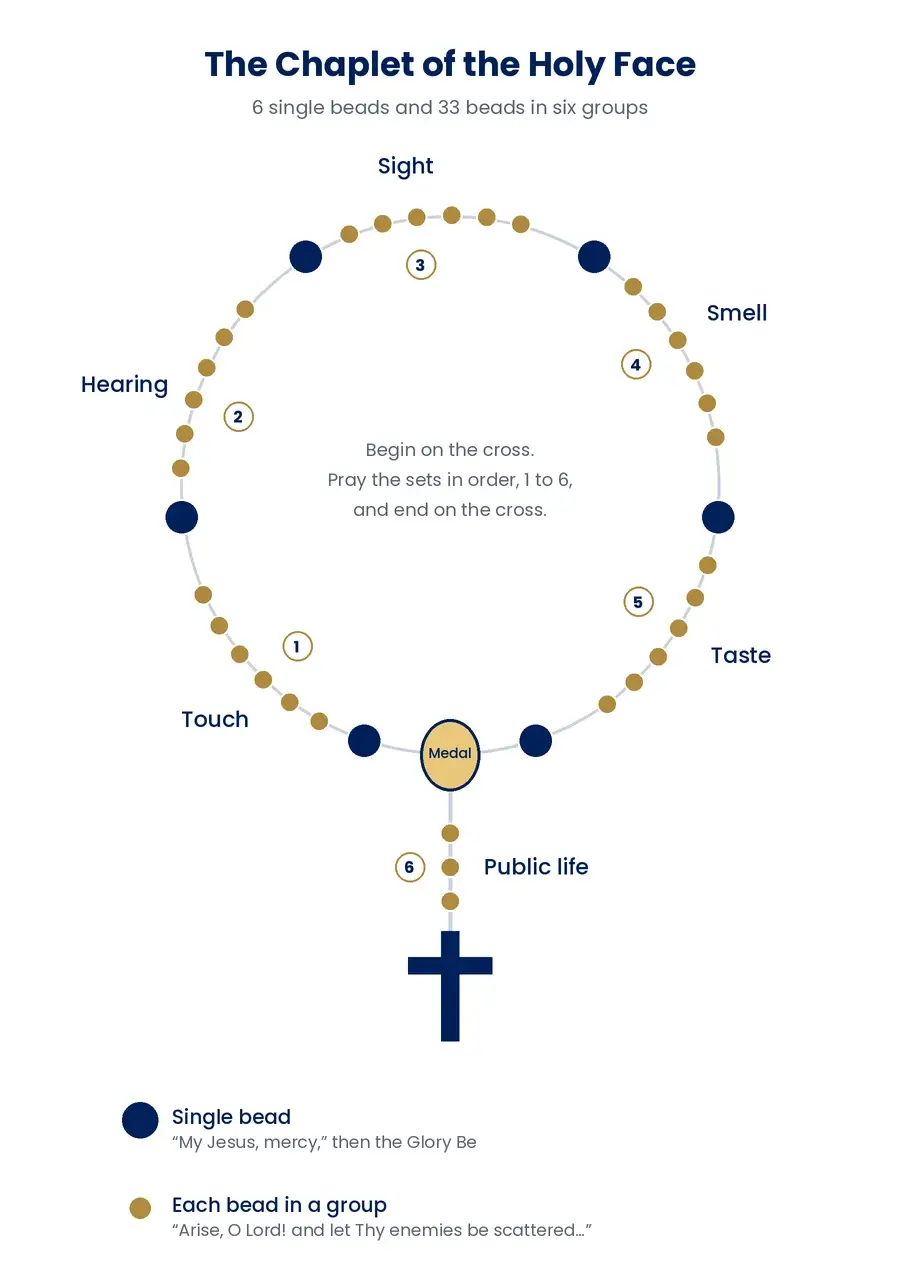
Make the Sign of the Cross. Then, on the cross, pray:
O God, come to my assistance; O Lord, make haste to help me.
Glory be to the Father, and to the Son, and to the Holy Spirit;
as it was in the beginning, is now, and ever shall be, world without end. Amen.
Each set honors one of Our Lord’s senses. Pray the five sets in this order: touch, hearing, sight, smell and taste.
On the single bead:
My Jesus, mercy. Then the Glory Be.
On each of the six beads:
Arise, O Lord! and let Thy enemies be scattered, and let them that hate Thee flee from before Thy Face.
On the last single bead, beside the medal:
My Jesus, mercy. Then the Glory Be.
On each of the three beads between the medal and the cross:
Arise, O Lord! and let Thy enemies be scattered, and let them that hate Thee flee from before Thy Face.
These three beads recall the three years of Our Lord’s public life and honor all the wounds of His Holy Face.
Pray:
God, our Protector, look on us and look on the Face of Thy Christ. Amen.
The Glory Be is prayed seven times in all: once on the cross and once on each single bead. The seven honor the seven last words of Jesus on the Cross and the Seven Sorrows of Our Lady.
Chaplet as prayed by the Discalced Carmelite Nuns of Sacramento.
Often prayed with the chaplet, the Golden Arrow Prayer was given to Sister Marie of St. Peter, a Carmelite nun of Tours, in 1843 as an act of praise in reparation for blasphemy:
May the most holy, most sacred, most adorable, most incomprehensible, and ineffable Name of God be forever praised, blessed, adored, loved, and glorified, in heaven, on earth, and under the earth, by all the creatures of God, and by the Sacred Heart of Our Lord Jesus Christ in the most Holy Sacrament of the Altar. Amen.
Text as published by the Discalced Carmelite Nuns of Sacramento.
The Chaplet of the Holy Face of Jesus is traditionally prayed on a chaplet consisting of six large beads and thirty-three small beads, together with a medal of the Holy Face.
The thirty-three small beads recall the thirty-three years of the earthly life of Our Lord Jesus Christ.
The Chaplet of the Holy Face is a Catholic devotion of reparation honoring the Sacred Face of Our Lord Jesus Christ. Closely associated with the revelations received by Sister Marie of St. Peter, a Carmelite nun in Tours, France, the devotion calls the faithful to make reparation for blasphemy, the profanation of Sunday, and offenses committed against God.
The Holy Face Chaplet contains thirty-nine beads. Thirty-three small beads recall the thirty-three years of the earthly life of Jesus Christ, while the prayers of the chaplet honor His Holy Face and implore God for mercy, reparation, and the defeat of evil.
At the heart of the devotion is also the Golden Arrow Prayer, an act of praise offered in reparation for blasphemy against the Holy Name of God.
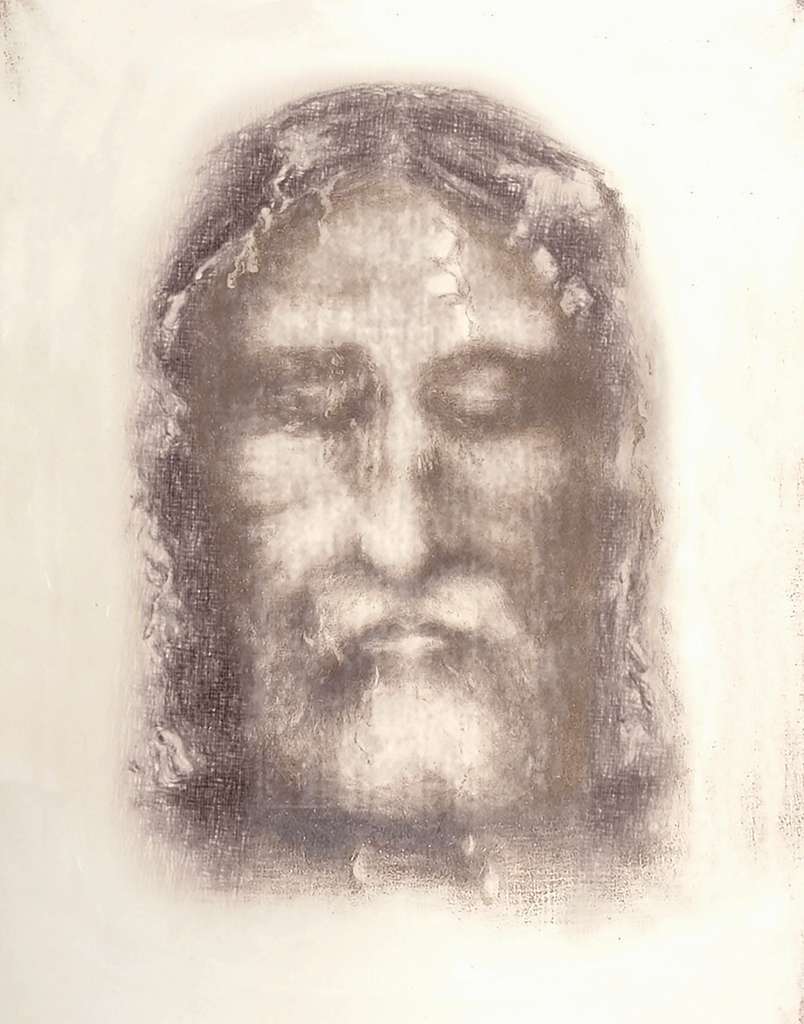
The Chaplet of the Holy Face is a devotion centered upon the suffering Face of Jesus Christ and offered in a spirit of reparation.
To contemplate the Face of Christ is to contemplate the Person who loves us.
During His Passion, the Face of Jesus was betrayed by a kiss, struck, spat upon, mocked, crowned with thorns, and disfigured by suffering. Devotion to His Holy Face therefore leads the Christian into contemplation of the Passion and into a desire to console the Heart of Christ through love, prayer, repentance, and reparation.
The chaplet is particularly associated with Sister Marie of St. Peter, a Discalced Carmelite nun of Tours, France, who reported receiving communications from Our Lord concerning reparation for blasphemy and the profanation of Sunday.
The traditional Holy Face Chaplet consists of thirty-nine beads: six large beads and thirty-three small beads.
The thirty-three small beads represent the thirty-three years of the earthly life of Jesus Christ.
Thirty of these beads are traditionally arranged into five groups of six. These groups are associated with the five senses—touch, hearing, sight, smell, and taste—and are offered in reparation for the sufferings and indignities endured by Our Lord, particularly in His Holy Face.
The remaining three beads recall the public life of Jesus.
The structure of the chaplet therefore turns the beads themselves into a meditation upon the earthly life and Passion of Christ.
The prayer repeated on the small beads—
“Arise, O Lord! and let Thy enemies be scattered, and let them that hate Thee flee from before Thy Face”
—draws upon the language of Psalm 67:2 in the traditional numbering (Psalm 68:1 in many modern Bibles).
Sister Marie of St. Peter was born Perrine Éluère on October 4, 1816, in Rennes, France. She eventually entered the Carmelite monastery at Tours.
Between 1843 and 1847, Sister Marie reported a series of interior communications concerning devotion to the Holy Face and the need for reparation.
Two offenses received particular emphasis: blasphemy against the Holy Name of God and the profanation of Sunday.
According to Sister Marie’s accounts, Our Lord desired a work of reparation in which His Holy Name would be praised and His Holy Face honored in response to these offenses.
This spirituality of reparation was not simply a matter of concentrating upon sin. Its purpose was fundamentally an act of love: answering offenses against God with adoration, praise, fidelity, and love.
Sister Marie died on July 8, 1848, at only thirty-one years of age, but devotion to the Holy Face continued to spread after her death.
In Catholic spirituality, reparation is an act of love offered to God in response to sin.
Sin cannot diminish God’s infinite glory, but it damages our relationship with Him and wounds the order of love among human beings. Acts of reparation seek to answer sin with greater love, praise, obedience, and devotion.
The Holy Face devotion places particular emphasis upon reparation for blasphemy and the profanation of Sunday.
Blasphemy dishonors the Holy Name of God. The Golden Arrow Prayer responds by blessing that Name:
praised, blessed, adored, loved, and glorified.
Likewise, where Sunday is neglected or treated as merely another day, the devotion calls Christians back to the sanctification of the Lord’s Day, worship of God, and the Holy Sacrifice of the Mass.
The purpose is not merely to lament the sins of others. Authentic reparation begins with our own conversion.
We first turn our own hearts toward Christ.
The Golden Arrow Prayer occupies a special place in the Holy Face devotion.
According to the writings associated with Sister Marie of St. Peter, blasphemy was compared to a poisoned arrow that wounds the Heart of God, while the prayer of praise was presented as a “Golden Arrow” offered in reparation.
Its language is striking because nearly the entire prayer consists of praise.
Where God’s Name is cursed, the Christian responds:
May the Name of God be praised.
Where it is treated without reverence:
May it be blessed.
Where God is rejected:
May He be loved and adored.
And the prayer concludes by uniting this praise with the Sacred Heart of Jesus in the Most Holy Sacrament of the Altar.
For Catholics devoted to the Holy Eucharist, this final line is especially beautiful. Reparation to the Holy Face leads directly to the Eucharistic Heart of Christ.
The Holy Face devotion spread significantly in Tours during the nineteenth century.
An important figure in its development was Leo Dupont, sometimes called the “Holy Man of Tours.” His home became associated with prayer before an image of the Holy Face and with the growing devotion in Tours.
After his death, the work continued.
In 1884, a Confraternity of the Holy Face was canonically established at Tours. The following year, Pope Leo XIII elevated the Confraternity to an Archconfraternity, helping the devotion spread far beyond Tours.
The historical statutes described its purpose as making reparation to the outraged majesty of God for blasphemy and the profanation of Sunday and as promoting devotion to the suffering Face of Jesus Christ.
The establishment of the Archconfraternity gave ecclesiastical structure to a devotion that had developed over decades through the spirituality associated with Sister Marie of St. Peter and the apostolate of Leo Dupont.
One of the most beloved saints associated with devotion to the Holy Face is St. Thérèse of Lisieux.
Her complete religious name was Sister Thérèse of the Child Jesus and of the Holy Face.
Devotion to the Holy Face became deeply important to Thérèse, particularly as she contemplated the humility, hiddenness, rejection, and suffering of Jesus.
For her, the Holy Face was not merely an image of physical suffering. It revealed the hidden love of Christ—Jesus humbled, rejected, and seemingly without earthly glory, yet infinitely worthy of love.
This dimension harmonized profoundly with Thérèse’s own “little way” of humility, trust, and hidden acts of love.
Her devotion helped carry the spirituality of the Holy Face into a new generation of Catholic life.
The Holy Face devotion invites us to linger over something that can easily be passed over when reading the Passion narratives: the Face of Jesus.
The Gospels tell us that Christ was spat upon, struck, mocked, and crowned with thorns.
The Face that Mary had gazed upon at Bethlehem was now bruised and dishonored.
The Face before which angels worship was treated with contempt.
The Face of the One through whom all things were created was hidden beneath blood, sweat, dust, and suffering.
The Christian who contemplates the Holy Face does not stop at suffering, however. The Face of the Crucified Christ is the Face of divine love.
He suffers willingly for our salvation.
Thus the Chaplet of the Holy Face is not merely a devotion of sorrow. It is a devotion of gratitude, love, conversion, and hope.
The Golden Arrow Prayer concludes with a beautiful reference to the Sacred Heart of Jesus:
“and by the Sacred Heart of Our Lord Jesus Christ in the most Holy Sacrament of the Altar.”
This connection between the Holy Face and the Eucharist is especially meaningful.
The Jesus whose Face was wounded during the Passion is the same Jesus whom Catholics adore in the Blessed Sacrament.
In Eucharistic Adoration, we do not see His human features with our bodily eyes. Yet faith tells us that He is truly present.
The Holy Face devotion can therefore lead naturally to Eucharistic Adoration: contemplating the suffering love of Jesus and responding to that love by remaining with Him.
The Chaplet of the Holy Face may be prayed at any time.
Some Catholics incorporate it into their daily prayers, while others pray it particularly when seeking to make reparation, to pray for the conversion of sinners, or to deepen their meditation upon the Passion of Christ.
It may be prayed privately, with a family, in a prayer group, or before the Blessed Sacrament.
The value of the devotion does not depend upon how frequently it is prayed. What matters is that it leads the person praying toward greater love of God, repentance for sin, reverence for His Holy Name, fidelity to Sunday worship, and deeper union with Jesus Christ.
The Chaplet of the Holy Face is a Catholic devotion honoring the suffering Face of Jesus Christ and offered in reparation, particularly for blasphemy and the profanation of Sunday. It is closely associated with Sister Marie of St. Peter and the nineteenth-century Holy Face devotion in Tours, France.
The traditional Holy Face Chaplet contains thirty-nine beads: six large beads and thirty-three small beads. The thirty-three small beads recall the thirty-three years of the earthly life of Jesus Christ.
On each of the thirty-three small beads, pray:
“Arise, O Lord! and let Thy enemies be scattered, and let them that hate Thee flee from before Thy Face.”
The Golden Arrow Prayer is a prayer of praise and reparation associated with Sister Marie of St. Peter. It blesses, praises, loves, adores, and glorifies the Holy Name of God in reparation for blasphemy.
Sister Marie of St. Peter was a nineteenth-century Carmelite nun in Tours, France. Between 1843 and 1847, she reported receiving interior communications concerning reparation for blasphemy and the profanation of Sunday and devotion to the Holy Face of Jesus.
No. A chaplet is a set of prayers traditionally prayed using beads, while a novena is a prayer or series of prayers traditionally offered over nine days. Both may form part of devotion to the Holy Face, but they are distinct practices.
The traditional Holy Face Chaplet has its own arrangement of six large and thirty-three small beads, so an actual Holy Face chaplet makes its structure easier to follow. If one does not have the proper beads, however, the prayers themselves may still be prayed without them.
O Jesus, through Your Holy Face, wounded and dishonored for love of us, draw our hearts to Yourself.
Where Your Holy Name is blasphemed, give us the grace to praise it.
Where Your commandments are rejected, give us the courage to obey them.
Where Sunday is forgotten, draw Your people back to the worship of God and the Holy Sacrifice of the Mass.
Where hatred has taken root, teach us charity.
Where sin has darkened the soul, bring the light of Your grace.
Where indifference has grown cold, kindle again the fire of divine love.
Lord Jesus, let the contemplation of Your Holy Face lead us to repentance, reparation, and deeper union with You.
May we recognize Your Face in the poor, the suffering, the forgotten, and those entrusted to our care.
And after seeking Your Face throughout our earthly lives, may we one day behold You face to face in the joy of Heaven.
O God, our Protector, look down, and look upon the Face of Thy Christ.
Amen.
An original prayer prepared for this page.
Share this prayer
Please know that every prayer request shared here is kept strictly confidential. Your request will go to the Brothers, who will intercede for you. We will place your intentions before our Eucharistic King during our daily hours of adoration.