The Confiteor, Latin for “I confess,” is the Church’s ancient prayer of sorrow for sin. Below is the traditional form said outside Mass, as printed in the Baltimore Catechism, followed by the Latin.
I confess to Almighty God, to blessed Mary, ever Virgin, to blessed Michael the Archangel, to blessed John the Baptist, to the holy Apostles Peter and Paul, and to all the Saints, that I have sinned exceedingly in thought, word and deed, through my fault, through my fault, through my most grievous fault. Therefore, I beseech blessed Mary, ever Virgin, blessed Michael the Archangel, blessed John the Baptist, the holy Apostles Peter and Paul, and all the Saints, to pray to the Lord our God for me.
May the Almighty God have mercy on me, and forgive me my sins, and bring me to everlasting life. Amen.
May the Almighty and merciful Lord grant me pardon, absolution, and remission of all my sins. Amen.
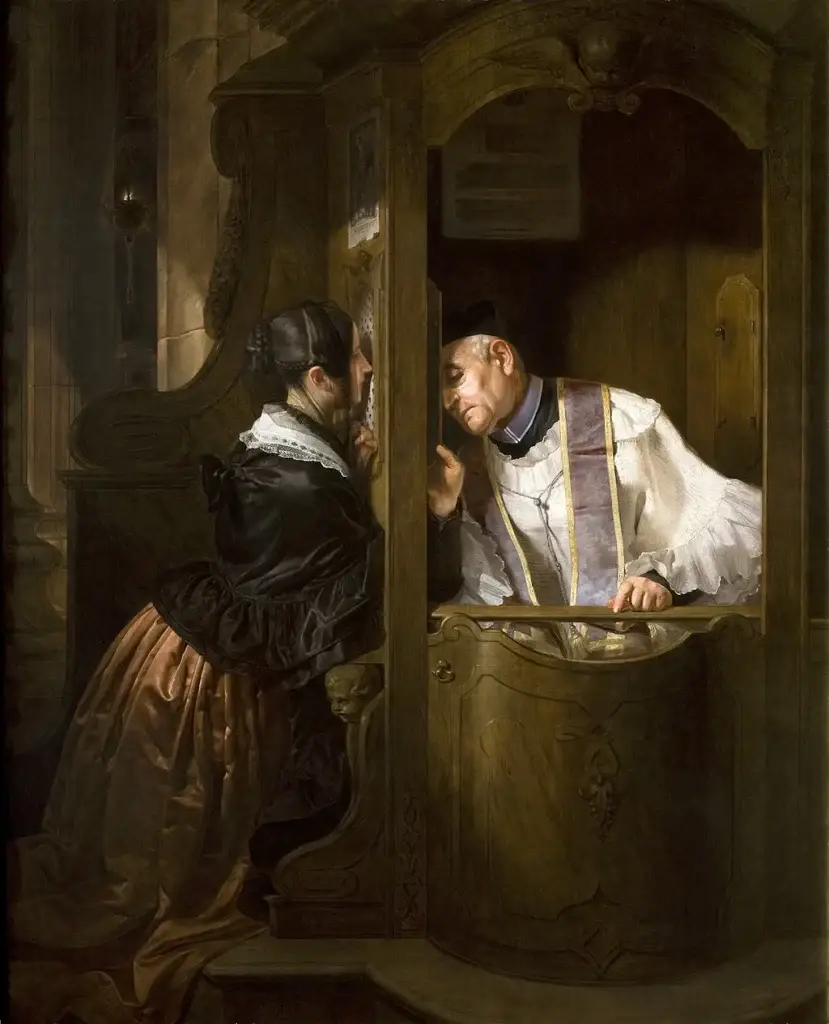
The Confession, by Giuseppe Molteni (1838). Public domain.
Confiteor Deo omnipotenti, beatae Mariae semper Virgini, beato Michaeli Archangelo, beato Joanni Baptistae, sanctis Apostolis Petro et Paulo, omnibus Sanctis, quia peccavi nimis cogitatione, verbo et opere: mea culpa, mea culpa, mea maxima culpa. Ideo precor beatam Mariam semper Virginem, beatum Michaelem Archangelum, beatum Joannem Baptistam, sanctos Apostolos Petrum et Paulum, omnes Sanctos, orare pro me ad Dominum Deum nostrum.
Pray it at night after examining your conscience, before going to Confession, or whenever you want to tell God of your sorrow for sin. Strike the breast at “through my fault, through my fault, through my most grievous fault.” In confession, and at the traditional Latin Mass, “and to you, Father” is added after the Saints are named in both halves of the prayer. At the current Mass, the Penitential Act uses a shorter, newer form of the Confiteor. The text above follows the Baltimore Catechism (1885).
Confiteor means “I confess.” The prayer admits our sins before God and the whole Church in heaven, naming Our Lady, St. Michael, St. John the Baptist and Sts. Peter and Paul, and then asks them all to pray for us.
The words, and the striking of the breast, express personal responsibility and true sorrow. We blame no one else; we stand honestly before God and ask His mercy.
No. The Confiteor is a prayer of repentance that disposes us for God’s mercy and, said with sorrow, can obtain the forgiveness of venial sins. A Catholic conscious of mortal sin must receive sacramental absolution in Confession before Holy Communion (CCC 1385).