
Updated October 2026: This article was substantially revised with current Church sources and pastoral guidance for Catholics with celiac disease or other serious dietary restrictions.
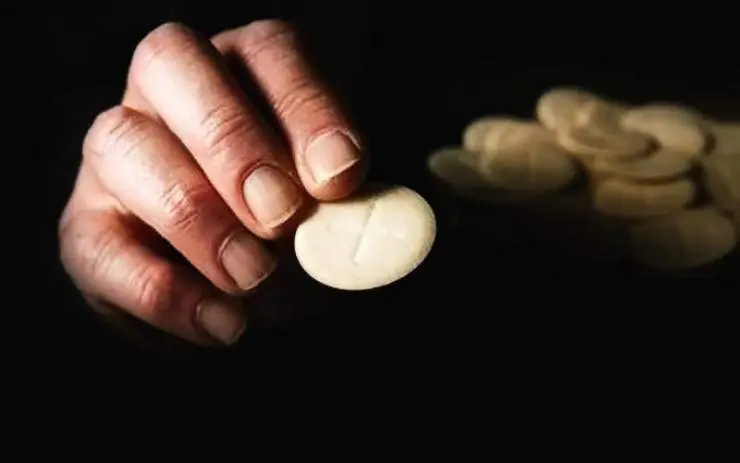
Catholics with celiac disease sometimes worry that they will be unable to receive Holy Communion safely or that an accommodation means receiving less of Our Lord. The Church takes both the validity of the sacrament and the health of the communicant seriously. Valid low-gluten hosts are available, and a person who cannot consume even a low-gluten host may receive the Precious Blood alone. In either case, the communicant receives the whole Christ.
Can a Communion Host Be Completely Gluten Free?
No. A host that is completely free of gluten is not valid matter for the Eucharist because altar bread must be made from wheat. Canon 924 of the Code of Canon Law states that the bread used for the Eucharistic sacrifice must be wheat bread. A host made from rice, corn, tapioca, or another non-wheat substance cannot be consecrated as the Body of Christ.
This is not a judgment about the dignity, faith, or needs of a person with celiac disease. The Church does not treat the material signs of the sacraments as interchangeable. Christ entrusted particular signs to the Church, and the Church must faithfully preserve what is necessary for a valid sacrament.
Are Low-Gluten Hosts Valid?
Yes. The Congregation for the Doctrine of the Faith clarified in 2003 that low-gluten hosts are valid when they contain enough gluten to make bread without adding foreign materials or using a process that changes the nature of bread. The Holy See repeated this teaching in its 2017 circular letter concerning the bread and wine used for Mass.
A valid low-gluten host is still made from wheat. It is not the same as an ordinary gluten-free food product, even when civil labeling rules may permit very low-gluten products to carry the words “gluten free.” Catholics should not bring an ordinary commercial gluten-free wafer to Mass. Parishes obtain altar breads made specifically for sacramental use and follow diocesan procedures for their handling.
Can Someone with Celiac Disease Receive the Precious Blood Alone?
Some people cannot safely consume even a very small amount of gluten. The Church provides for them to receive Holy Communion under the species of wine alone. This is not a lesser Communion. Jesus Christ is fully present under each Eucharistic species: Body, Blood, soul, and divinity.
The Catechism explains in paragraph 1390 that Christ is sacramentally present under each species (see also CCC 1412–1413). Accordingly, receiving from the chalice alone is receiving the whole Christ and all the fruit of Eucharistic grace. The 2003 norms explicitly state that a layperson with celiac disease who cannot receive even a low-gluten host may receive under the species of wine alone.
What Is Mustum?
Mustum is grape juice in which fermentation has begun but has been suspended without altering its nature. The Church recognizes mustum as valid matter for the Eucharist. It may be permitted for a person who cannot consume ordinary sacramental wine, including because of alcohol intolerance or another grave reason. Its use is governed by the competent Church authority and should be arranged through the pastor rather than privately improvised.
Mustum and low-gluten hosts address different needs. A Catholic who cannot consume gluten may receive from the chalice alone. A person unable to consume normal wine may be able to receive a host or, where appropriate and permitted, mustum.
Speak With Your Pastor Before Mass
If you have celiac disease, a wheat allergy, or another serious medical concern, contact the parish before the Mass you plan to attend. A quiet conversation ahead of time gives the priest and sacristan an opportunity to prepare a safe and reverent arrangement.
- Ask whether the parish has Church-approved low-gluten hosts and how they are obtained.
- Explain whether you can tolerate a low-gluten host or need to receive from the chalice alone.
- Ask that the host be handled separately from ordinary hosts to reduce the danger of cross-contact.
- If receiving from the chalice alone, ask whether a separate chalice can be prepared without a fragment of the host.
- Follow the parish or diocesan procedure rather than supplying an unapproved host yourself.
No parish can promise that every environment is completely free from cross-contact. Medical tolerances also differ. Discuss your individual health needs with a qualified medical professional and give the parish enough information to make a careful arrangement.
You Are Not Separated From Christ
A dietary illness can make an already personal act of worship feel complicated or conspicuous. Yet the Church’s provisions are meant to help the faithful receive Our Lord validly, reverently, and as safely as possible. Whether you receive a valid low-gluten host or the Precious Blood alone, you receive Jesus Christ whole and entire.
To reflect more deeply on this mystery, read Why the Eucharist Is the Source and Summit of Christian Life. You may also prepare for Communion with these prayers before and after Mass.