
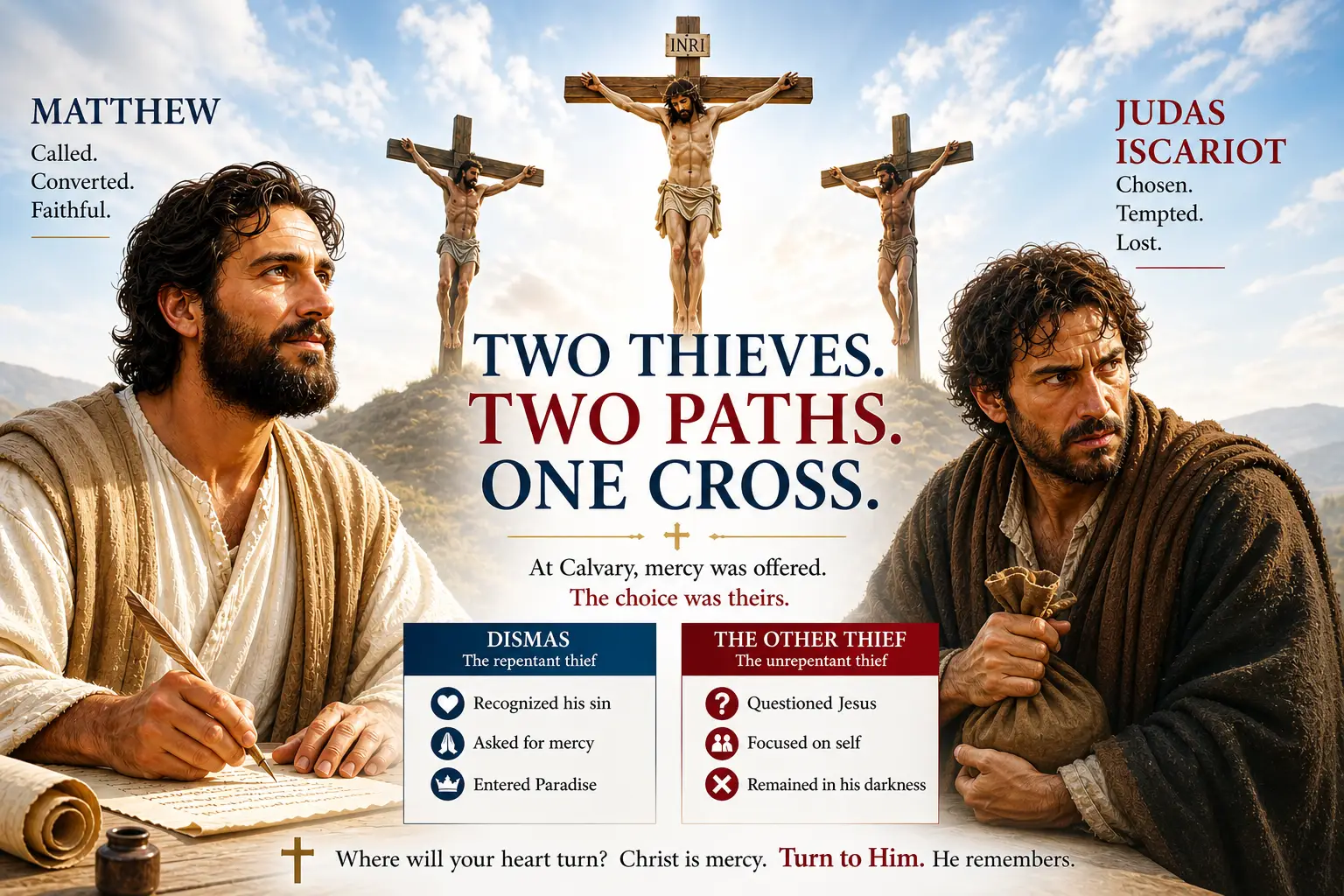
On one side, a thief. On the other side, another thief. Two men, yet two very different responses to the same moment. We know this scene well: Calvary. As far as we know, only one of them enters into life with God. Tradition calls him Dismas, the repentant thief, the one who “stole heaven.” The other remains unnamed.
But the scene does not end with two thieves alone. In a deeper sense, Calvary reveals many kinds of thieves: those who ask Jesus to remember them, and those who demand something from Him without trust. Those at His right hand, and those whom He says He never knew.
For this reflection, two other men stand alongside these figures: Matthew and Judas Iscariot. Both were chosen as apostles. Both were, in their own ways, thieves.
Matthew was a tax collector, seen as a traitor to his own people. He cooperated with the Roman occupiers and profited from it. In the eyes of the Jewish people, he was not just dishonest, but corrupt. Yet when Jesus passed by and said, “Follow me,” Matthew rose and left everything behind. Scripture gives no record of him returning to his old ways. His life becomes a testimony of conversion.
Pope Benedict XVI once noted how little we know about Matthew’s life in detail, yet emphasized something essential: the Gospel is precisely this, God’s grace offered to the sinner. Matthew, once considered among the worst, is entrusted with proclaiming the Word of God. That reversal is not sentimental. It is a real transformation.
Matthew reflects something of Dismas. Both turn toward Christ. Both recognize, in their own way, that their past does not define their future. It is tempting to admire such conversions from a distance, as if they belong only to dramatic lives. But the uncomfortable truth is simpler: we are sinners too. We also stand in need of mercy.
Judas, however, presents a different path. Like Matthew, he was chosen. Like Matthew, he walked with Christ. Yet something within him remained divided. The Gospels suggest motives ranging from greed to disappointment, even noting that Satan entered into him. Whatever the cause, Judas turns away.
And yet, even in Judas, there is a moment of movement. He returns the silver. He acknowledges his sin: “I have sinned in betraying innocent blood.” But instead of turning fully to Christ, he turns inward, collapsing under the weight of his guilt.
Here, he resembles the other thief on Calvary. This thief also turns toward Jesus, but only partially. “Are you not the Messiah? Save yourself and us.” It is a request, but not a surrender. It focuses on what Jesus can do, not on who He is.
This is the dividing line.
Dismas turns to Jesus with humility: “Remember me.” He does not demand rescue from suffering; he entrusts himself in the midst of it. Judas and the other thief, by contrast, struggle to move beyond themselves. They recognize something is wrong, but they do not fully abandon themselves to mercy.
This tension is not distant from us. We often approach God in the same way. We ask to be saved, but rarely ask from what. The deeper answer is uncomfortable: from ourselves. From sin, from pride, from the illusion that we can carry the weight of our lives alone.
There is also a deeper issue at play: the struggle to recognize dignity. Judas and the unrepentant thief seem unable to see Christ for who He is. They focus on His power, not His person. They want results, not a relationship.
Yet the mystery of the Incarnation answers this directly. God becomes man not to display power, but to reveal love. He enters into suffering, allows Himself to be rejected, and speaks forgiveness from the Cross. Not because humanity deserves it, but because He wills our good.
In the end, Calvary is not just a historical event. It is a mirror.
We stand there too.
Like Matthew, we are called to rise and follow. Like Dismas, we are invited to trust in mercy even at the last moment. Like Judas and the other thief, we risk turning inward, stopping short of true surrender.
Becoming a “thief” is not difficult. Sin comes easily. The question is: what kind of thief will we be?
A thief who takes and hides, or one who, in humility, “steals” heaven by trusting in Christ.
Jesus allowed Himself to be placed between both kinds. He did not refuse either presence. And long before Dismas spoke, God had already remembered him.
That same grace remains available now.
Every time we approach the Cross, every time we come to the Eucharist, we stand again at Calvary. The choice remains the same: to turn toward Him fully, or to remain turned in on ourselves. God, in His mercy, continues to receive even thieves.