
Originally published December 15, 2014. Substantially revised in October 2026 for doctrinal clarity, reliable sourcing, and pastoral usefulness.
Do animals have souls? Catholic teaching answers yes—but not in exactly the same sense as when we speak of the human soul. Animals are genuinely alive, able to sense, desire, remember, and form bonds. Their souls are the principle of that animal life. The human soul, however, is spiritual and rational, created directly by God and able to survive bodily death.
This distinction helps Catholics appreciate animals without erasing the unique dignity of the human person. It also helps us respond carefully to the tender question many people ask after losing a beloved pet: Will I see my animal again in heaven?
What Does “Soul” Mean?
In classical Catholic philosophy, a soul is the principle that makes a living body alive. Plants have vegetative life: they grow, take nourishment, and reproduce. Animals also possess sensitive life: they perceive, move, experience appetites, and respond to their surroundings. Human beings possess these powers together with intellect and free will.
The word soul therefore does not automatically mean an immortal spirit. When Catholics say that an animal has a soul, they mean that it has an interior principle of animal life. When we say that a human being has a spiritual soul, we mean something more: the human person can know truth, freely choose the good, love God, and is called to eternal communion with Him.
What St. Thomas Aquinas Teaches About Animal Souls
St. Thomas Aquinas explains that an animal’s sensitive soul operates through bodily organs. Because it does not possess an operation independent of the body, it is not subsistent after the animal dies (Summa Theologiae I, q. 75, a. 3). The human intellectual soul is different. Our acts of understanding are not reducible to a bodily organ, so the rational soul is spiritual, subsistent, and incorruptible (I, q. 75, aa. 2 and 6).
This does not mean animals are machines or unimportant. They are living creatures made by God, and their goodness does not depend upon possessing an immortal rational soul. Each animal reflects something of the wisdom, beauty, and generosity of its Creator.
Do Dogs and Other Animals Go to Heaven?
No one can promise that a particular dog or cat is in heaven, and no one can rule it out. The Church has not defined that individual animals either will or will not be present in the renewed creation. We should therefore avoid two claims that go beyond what has been revealed: “Every pet certainly goes to heaven,” and “There can be no animals in the world to come.”
Heaven is the blessed communion of rational creatures with the Triune God. Human beings are judged, purified, and raised in Christ; animals are not moral agents and do not receive judgment as human persons do. At the same time, Scripture speaks of a renewed creation, and the Church teaches that the universe itself will be transformed. We may entrust our unanswered questions to God, whose wisdom and goodness exceed our imagination.
For someone grieving a pet, the faithful response is not coldness. Gratitude, sorrow, and affection are natural. We can thank God for the companionship we received, care for animals still entrusted to us, and place our hope in God rather than in a promise the Church has never made.
Did Pope Francis Say Animals Go to Heaven?
No. In December 2014, newspapers and social media attributed to Pope Francis the claim that Paradise is open to all God’s creatures. The sentence does not appear in his address.
In the official November 26, 2014 general audience, Pope Francis reflected on the Kingdom of God and the destiny of creation. Citing Romans 8:21, he taught that creation will be freed from corruption. He described the new creation not as the annihilation of the cosmos, but as the bringing of all things to their fullness of being, truth, and beauty. He did not say that every animal possesses an immortal soul or that every pet will enter heaven.
The real teaching is beautiful enough without a fabricated quotation: God will not abandon His creation, Christ’s Resurrection has begun its renewal, and the final transformation remains a mystery greater than we can picture.
How Catholics Should Treat Animals
The Catechism gives clear moral guidance even where speculative questions remain open. Animals are God’s creatures, and human beings owe them kindness. They may be used for food, clothing, work, and legitimate scientific purposes within reasonable limits, but it is contrary to human dignity to make them suffer or die needlessly (CCC 2415–2418).
The Catechism also warns against directing toward animals the affection due to human persons. Loving an animal should deepen—not replace—our love of God and neighbor. Responsible care includes food, shelter, humane treatment, necessary veterinary attention when possible, and wise decisions when an animal is suffering.
A Franciscan Love of Creation
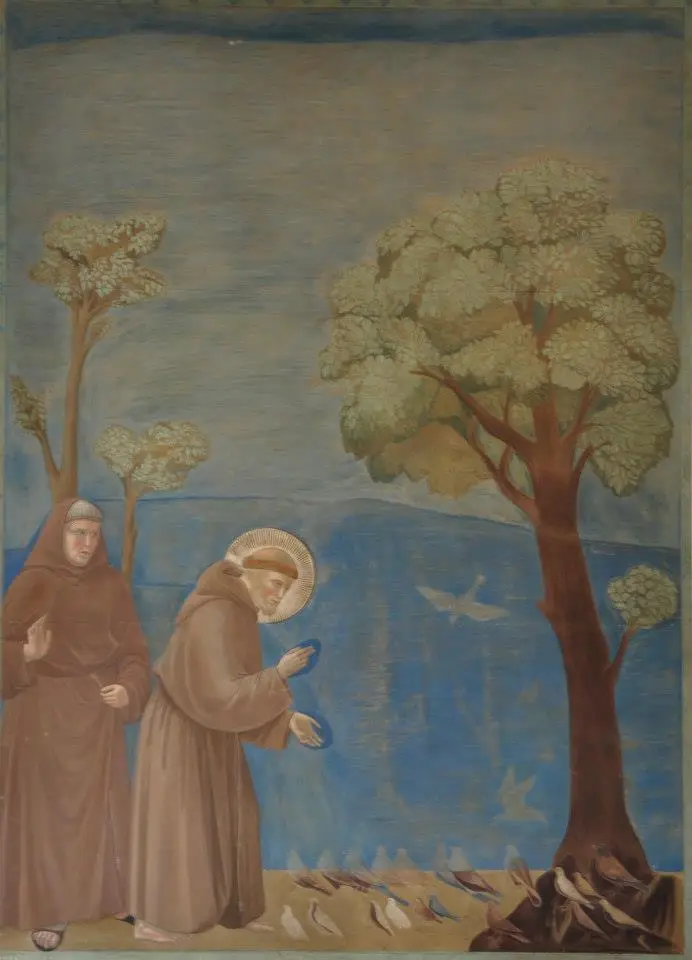
St. Francis of Assisi did not love creatures as substitutes for God. He loved them because they came from God and led his heart back to their Creator. That is the sound Catholic pattern: cherish creation, recognize humanity’s unique vocation, and praise the Lord through everything He has made.
The prayers by St. Francis of Assisi offer a beautiful way to enter that spirit of gratitude. Animals can awaken tenderness, responsibility, wonder, and praise in us. Those gifts are real, even when some questions about the life to come remain unanswered.
Hope Without Inventing Certainty
Catholic faith gives us something better than a sentimental slogan. It teaches that animals are good creatures, that human beings possess unique spiritual dignity, that cruelty is sinful, and that all creation awaits renewal in Christ. What God has not revealed, we can leave peacefully in His hands.
We may grieve an animal we loved, thank God for its life, and trust that nothing good is lost from His providence. Our final hope is not simply to recover every earthly consolation. It is to see God face to face—and in Him to receive a joy greater than anything we can now imagine.