
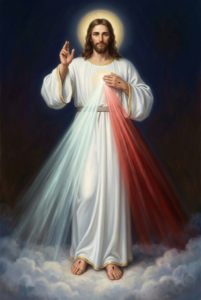
 The Lord is gracious and merciful! slow to anger and abounding in steadfast love” (Psalm 103:8). His love is not fragile, and it is not limited. It does not run out when we fail, and it is not reduced by our weakness. It remains steady, even when we are not.
And yet, we often struggle to believe this. We look at our sins and feel discouragement. We wonder how God could continue to love us so freely when we ourselves feel so unworthy. But the answer is not found in our self-perception. It is found in what God has revealed.
He has shown us His love most profoundly in the Holy Eucharist, where He remains with us daily, not only present, but desiring communion with us. He is not a distant God; He stays.
Scripture confirms this mercy. St. Peter reminds us that love covers a multitude of sins. In the Gospel, we see the woman who wept at the feet of Christ, and hear the words: “Many sins have been forgiven her because she loved much.” God’s mercy is not reluctant. It is generous. Even startling in its depth.
The saints understood this in a way that challenges human logic. St. Thérèse of Lisieux said, “A God who became so small could only be love and mercy.” And Saint Faustina Kowalska recorded the words of Christ: “Let no soul fear to draw near to Me, even though its sins be as scarlet. My mercy is greater than your sins and those of the entire world… The graces of My mercy are drawn by one vessel only, and that is trust.”
What stands out in this message is not only mercy, but trust. According to this spiritual insight, what wounds the Heart of Christ is not the presence of sin, but the absence of trust in His mercy. That alone reframes the entire spiritual struggle.
We were created from love, for love, and to live in love. Without it, the human heart becomes restless and disoriented. God does not love us in a general way, but personally. He knows each of us completely, even to the smallest detail. Nothing in our lives is hidden from Him.
And yet, when suffering comes, we often assume God is absent. We feel unheard or forgotten. But faith calls us beyond what we feel into what is true. God sees what we cannot see. He understands what we cannot yet understand. Trust becomes the bridge between confusion and peace.
St. Faustina once wrote that loving surrender to the will of God carries more weight than severe penances. That is because love is not measured by intensity of feeling, but by fidelity of will. True love remains even when emotions do not.
We may think we are unworthy of God’s love. But that is precisely why it is called mercy. If we understood even partially the depth of His love, despair would lose its grip on us. We would discover that we are held more firmly than we realize.
This is why evangelization, in its simplest form, is so powerful. As Mother Angelica once said, “The essence of evangelization is to tell everybody: Jesus loves you.” It is simple, but it is everything. When that truth is believed, it changes the way a person lives.
Finally, we turn to Mary, who stood at the foot of the Cross. We ask her to teach us how to remain faithful in suffering, how to trust when we do not understand, and how to love without fear.
We entrust ourselves to her care, asking her to lead us ever closer to the Heart of Christ, where love is not only spoken, but given without measure.