
I once had a challenging teacher, Dr. Floyd Centore, who asked a question that stayed with me long after the class ended: Is it possible for an entire society to be influenced by darkness? Not in a simplistic or exaggerated sense, but in the sense that the sum total of human actions, decisions, and habits can shape a culture’s moral direction. It is a difficult question, and not a new one. Human history repeatedly shows how whole communities can drift, slowly and almost unnoticed, away from truth and toward disorder.
Even Pope Leo XIII, faced with the cultural and spiritual upheavals of his time, reflected deeply on the reality of spiritual struggle in the world and the need for prayerful vigilance. The Church has never treated the question of evil as merely symbolic or psychological, but neither has it reduced reality to fear. There is always a balance between acknowledging spiritual struggle and remembering the greater reality of God’s sovereignty.
In more recent times, Archbishop Coakley addressed a serious situation involving the recovery of a stolen sacred Host and the attempted desecration connected to it. His concern was not sensational, but pastoral. He emphasized both the seriousness of such acts and the spiritual danger they pose, not to provoke fear, but as a reminder that the sacred is not abstract. When we speak of the Eucharist, we are speaking of Christ Himself, truly present.
At the same time, the Christian response is never meant to be anxiety or fixation on darkness. The center of the faith is not fear of evil, but confidence in Christ. The reality of spiritual struggle is always met with an even greater reality: grace.
This is why the Church consistently calls the faithful to prayer rather than panic. We are invited to intercede for the conversion of hearts through the Two Hearts, the Sacred Heart of Jesus and the Immaculate Heart of Mary. These devotions are not symbolic poetry, but expressions of trust that love is stronger than sin, and mercy is deeper than human failure.
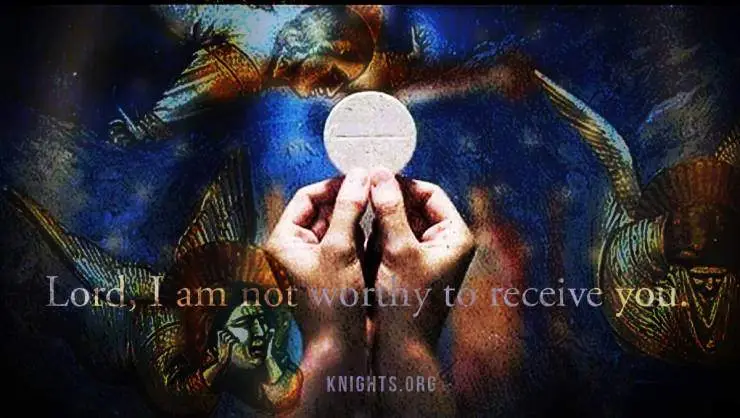
Even the simplest prayer at Mass carries this humility: “Lord, I am not worthy to receive you…” It is not a statement of despair, but of truth. It acknowledges human weakness while opening the door to divine mercy.
In the end, the question is not whether darkness exists in the world, but whether Christ is allowed to remain at the center of our response to it. The Christian life is not defined by fear of evil, but by steady trust that grace is already at work, quietly restoring what is broken and calling hearts back to God.