
Originally published June 30, 2015; substantially revised in October 2026.
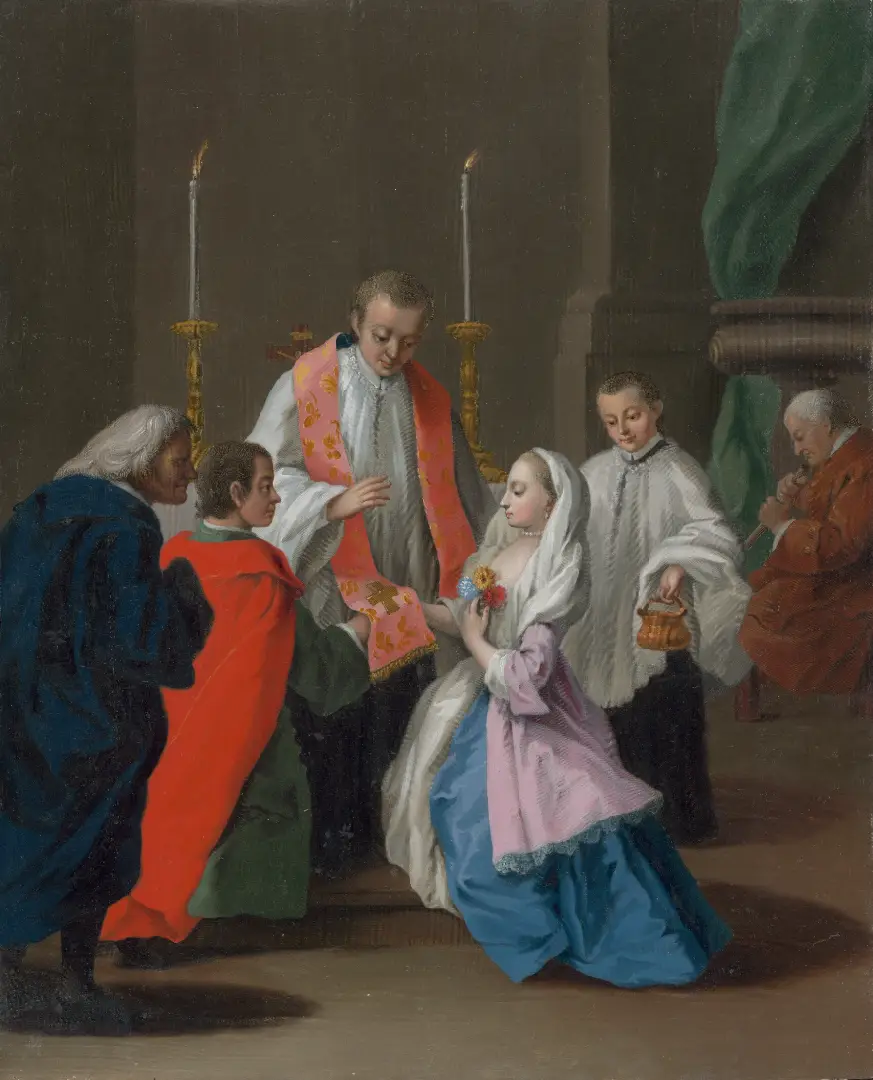
A Catholic wedding is more than a private promise witnessed in a church. It is a sacred celebration in which a man and a woman freely give themselves to one another before God and the Church. The Catholic wedding liturgy reveals what Christian marriage is: a lifelong covenant, ordered to the good of the spouses and the welcoming and education of children, raised by Christ to the dignity of a sacrament between the baptized.
This is why the Church’s teaching about marriage and her worship belong together. The liturgy does not invent marriage, and it does not merely decorate a civil contract with religious language. It receives human marriage as part of God’s plan and celebrates the grace Christ gives spouses to live their vocation faithfully.
What Is Catholic Marriage?
The Catechism of the Catholic Church defines the matrimonial covenant as the partnership of a man and a woman for the whole of life. By its nature, this covenant is directed toward the good of the spouses and the procreation and education of children. When two baptized persons enter it validly, Christ makes their covenant a sacrament.
Marriage therefore involves more than affection, legal recognition, or personal fulfillment. It is a natural institution established by the Creator before it is recognized by either Church or state. The spouses consent to a communion that is faithful, exclusive, and permanent. The bodily complementarity of man and woman belongs to this communion: their marital union expresses the gift they have promised and is of its nature ordered toward the generation of new life, even when a particular couple is unable to conceive.
None of this reduces marriage to a list of rules. At its center is a vocation to love. The husband and wife are called to help one another grow in holiness, to forgive, to bear one another’s burdens, and to make their home a place where faith can take root.
Why Is Marriage Celebrated in the Liturgy?
The liturgy makes Christ’s saving work present through signs, words, prayer, and sacramental action. Because Matrimony is one of the seven sacraments, its celebration belongs to the worship of the Church.
In the Latin Church, a marriage between two Catholics normally takes place within Mass. The Catechism explains that this practice reflects the connection of every sacrament with the Paschal Mystery of Christ. At the altar, the self-giving love of the bride and groom is placed beside the perfect self-gift of Jesus, who loved the Church and gave himself for her.
The Second Vatican Council (Sacrosanctum Concilium 77–78) asked that the marriage rite clearly express the grace of the sacrament and teach the duties of the spouses. The readings, questions before consent, exchange of consent, blessing and giving of rings, nuptial blessing, and—when marriage is celebrated during Mass—the Eucharist all disclose the meaning of the covenant being formed.
The Consent of the Bride and Groom
In the Latin tradition, the bride and groom confer the sacrament upon each other by freely expressing their consent before the Church. Their “I do” is not simply a description of their present feelings. It is a binding act of the will by which each receives the other and promises fidelity for life.
The priest or deacon receives their consent in the name of the Church and gives the Church’s blessing. The witnesses and congregation are not merely spectators. They represent the Christian community that rejoices in the marriage, prays for the couple, and should support them in living their vows.
This public and ecclesial character protects the dignity of consent. The Church requires that consent be free, that the couple understand the essential meaning of marriage, and that no impediment prevent a valid union. Careful marriage preparation serves that freedom by helping the couple enter the covenant with honesty and maturity.
What the Wedding Liturgy Teaches
The Catholic wedding liturgy teaches through both word and action:
- Marriage is a covenant. The spouses give themselves to one another rather than merely exchanging services or benefits.
- Marriage is faithful and lifelong. Their promises are made without reservation and endure in prosperity and adversity.
- Marriage is fruitful. The couple is asked to receive children lovingly from God and raise them according to the law of Christ and his Church.
- Marriage needs grace. Human love is real and beautiful, but spouses need Christ’s help to forgive, persevere, and love sacrificially.
- Marriage belongs to the Church’s mission. A faithful Christian home bears witness to God’s covenant love in the world.
Marriage, the Eucharist, and Daily Self-Gift
When Matrimony is celebrated during Mass, the connection between the marital covenant and Christ’s covenant with the Church becomes especially visible. In the Eucharist, Christ gives himself completely. Christian spouses are called to learn that same pattern of self-giving love in the ordinary sacrifices of family life, which is why St. John Paul II (Familiaris Consortio 56–57) called the Eucharist the very source of Christian marriage.
This article focuses on what the marriage liturgy celebrates. For a fuller reflection on how Holy Communion strengthens spouses after the wedding day, read The Eucharist and Marriage: Strength for Self-Giving Love.
Speaking the Truth with Charity
The Church’s teaching that marriage can exist only between one man and one woman is not a judgment on anyone’s human dignity. Every person is created in the image of God and must be treated with respect. The Catechism (2357–2359) specifically teaches that people who experience same-sex attraction must be accepted with “respect, compassion, and sensitivity,” and that unjust discrimination against them must be avoided.
The experience of same-sex attraction is not itself a sin. Like every Christian, however, a person who experiences it is called to chastity. The Church teaches that sexual acts belong within marriage and that same-sex sexual acts cannot express the marital union of husband and wife.
At the same time, charity does not require the Church to change the truth about marriage that she has received. A civil law can attach the word marriage to a same-sex union, but it cannot transform that union into marriage in the natural or sacramental sense. The Church therefore cannot bless or celebrate such a union as a marriage. She must proclaim what is true while rejecting mockery, hostility, and contempt.
This distinction matters pastorally. Catholics should defend the truth about marriage without reducing people to political categories or making anyone feel unwelcome in the search for God. Fidelity and compassion are not enemies. Both flow from Christ, who calls every person to conversion and offers grace for the journey.
Let the Liturgy Shape Married Life
The wedding rite lasts only a short time, but its promises are meant to shape a lifetime. Married couples can return spiritually to their vows by praying together, participating faithfully in Sunday Mass, receiving the Sacrament of Penance, practicing forgiveness, and placing Christ at the center of their home.
The Church also has a responsibility after the wedding. Parishes, relatives, friends, and other married couples should accompany spouses through illness, financial strain, parenting, infertility, grief, and every season that tests their promises.
If you are praying for your own marriage or for a couple you love, our Prayer for God’s Blessing on Married Couples can help you entrust that marriage to the Lord.
When Catholics celebrate marriage reverently, the liturgy does more than mark a joyful occasion. It proclaims that faithful love is possible with God’s grace, that the family has a vocation in the Church, and that human love finds its deepest meaning in the covenant love of Christ.