
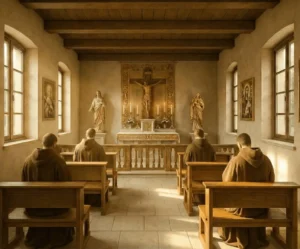
Christ the Lord, High Priest taken from among men, has made a new people “a kingdom and priests to God the Father.” This is not symbolic language meant only for clergy or religious figures. It is the identity of every baptized Christian. Through baptism and the anointing of the Holy Spirit, each person is consecrated as a spiritual house and a holy priesthood. The Church is not only an institution with priests; it is a priestly people.
As Lumen Gentium teaches: “The baptized, by regeneration and the anointing of the Holy Spirit, are consecrated as a spiritual house and a holy priesthood, in order that through all those works which are those of the Christian man they may offer spiritual sacrifices and proclaim the power of Him who has called them out of darkness into His marvelous light.”
This changes the way ordinary life is understood. Holiness is not confined to liturgical spaces or explicitly religious actions. It extends into everything: work, study, family life, suffering, rest, and even the unnoticed moments of the day. Nothing is wasted when it is united to Christ. The Christian life becomes a continuous offering.
To “offer spiritual sacrifices” does not mean performing extraordinary feats. It means allowing the everyday reality of life to be taken up into something greater. A sacrifice, in this sense, is anything freely given to God. It can be joy, gratitude, effort, patience, or even struggle and fatigue. What matters is not the external size of the act, but the interior intention behind it.
This is where the practice of offering your day takes on real meaning. You can offer your day, your prayers, your works, your struggles, and your suffering for the good of others. This is not abstract spirituality. It is a concrete way of participating in Christ’s own priesthood. Just as Christ offered Himself for the salvation of the world, the baptized are invited to unite their daily lives to that same offering.
One simple way to live this is by giving your day a specific intention. At the beginning of the morning, you choose someone or something to pray for throughout the day. It might be a family member, a friend, someone who is suffering, or a particular need in the Church or the world. That intention becomes a quiet thread running through everything you do.
Throughout the day, you can renew it in small moments: before work, during a break, in moments of difficulty, or even in passing thoughts. These renewals do not need to be elaborate. They are often as simple as a brief prayer of offering, silently uniting what you are doing to God for that intention.
This practice gradually transforms the way time is experienced. The day is no longer just a sequence of tasks to complete or problems to manage. It becomes something intentionally given. Even interruptions and inconveniences take on meaning when they are offered rather than merely endured.
It also deepens awareness of communion within the Church. No Christian lives or suffers alone. When one person offers their day for another, an invisible exchange of grace takes place. Prayer becomes participation in the life of others, even across distance and silence.
To live this priestly identity is not to add pressure or complexity to daily life. It is to uncover a hidden depth already present in it. The baptized are already consecrated. The offering is already possible. The only question is whether it is intentionally lived or quietly forgotten.
In this way, even the most ordinary day becomes an altar, and the life of a Christian becomes a continual participation in Christ’s own offering to the Father.
To help you live this daily offering, we include an offering prayer and a list of intentions for each day of the week.