
Originally published October 31, 2015. Revised October 3, 2026, for the feast of St. Faustina Kowalska.
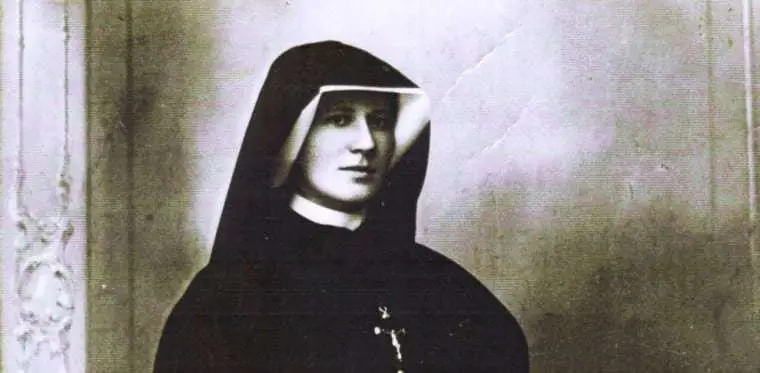
Who Was St. Faustina?
Who was St. Faustina? Saint Maria Faustina Kowalska was a Polish religious sister and mystic whom St. John Paul II called “a gift of God to our time.” Born Helena Kowalska on August 25, 1905, she entered the Congregation of the Sisters of Our Lady of Mercy in Warsaw in 1925 and received the religious name Sister Maria Faustina. She died in Kraków on October 5, 1938, at only thirty-three years of age.
Her outward life was quiet. She served her community through ordinary work as a cook, gardener and porter. Yet within that hidden life, she believed Christ entrusted her with a mission: to remind the world of God’s merciful love, to call sinners to trust in Him and to encourage Christians to practice mercy toward their neighbors.
Pope St. John Paul II canonized her on April 30, 2000. In his canonization homily, he explained that her message is not a new Gospel. Rather, it is a special light that helps the Church proclaim the mercy revealed in the death and Resurrection of Jesus Christ.
Why Did St. Faustina Write a Diary?
St. Faustina wrote at the direction of her confessors and spiritual directors. The resulting work, commonly called the Diary of Saint Maria Faustina Kowalska: Divine Mercy in My Soul, records her prayer, struggles, spiritual growth and reported encounters with Christ.
The St. Faustina diary is not merely a collection of extraordinary experiences. It reveals a soul learning humility, obedience, trust and sacrificial love in the ordinary duties of religious life. Her writings repeatedly return to a central conviction: no human misery is greater than God’s mercy, and no sinner should surrender to despair.
The Church distinguishes private revelations from the public revelation given in Scripture and Sacred Tradition. Private revelations do not add to the deposit of faith, nor are Catholics required to accept them as articles of faith. Their proper role is to help believers live the Gospel more fully in a particular period of history. St. Faustina’s message must therefore always be understood in harmony with Scripture, the sacraments and the teaching of the Church.
The Heart of the Divine Mercy Message
St. Faustina’s mission can be summarized in three movements: ask God for mercy, trust in His mercy and show mercy to others. Divine Mercy is not permission to ignore sin. It is God’s compassionate love reaching the sinner, calling that person to repentance and restoring communion with Him.
The familiar words associated with the Divine Mercy image—“Jesus, I trust in You”—express this response. Christian trust is not the belief that life will be painless. It is confidence that Christ’s love is stronger than sin, fear and death.
In his canonization homily, St. John Paul II connected the rays in the Divine Mercy image with the blood and water that flowed from the pierced side of Christ. He pointed especially to the Eucharist, Baptism and the gift of the Holy Spirit. Divine Mercy is therefore deeply sacramental: Christ does not offer humanity a vague feeling of reassurance, but the saving grace that flows from His Paschal Mystery.
Mercy Must Become a Way of Life
St. Faustina’s spirituality does not end with receiving consolation. Those who receive mercy are called to become merciful. St. John Paul II emphasized that love of God and love of neighbor cannot be separated. Forgiving injuries, bearing patiently with others, serving people in need and praying for sinners are practical ways of living the message entrusted to St. Faustina.
This is one reason her hidden religious life remains so compelling. Her mission grew from prayer, obedience and humble service rather than public influence. Her example can also encourage anyone trying to discern a vocation to religious life: God can accomplish great work through a person who gives Him an undivided heart.
What Can We Learn from St. Faustina Today?
First, no one is beyond the reach of God’s mercy. Sin is serious, but despair is never the Christian answer. Christ continually calls us to conversion, especially through prayer, the Sacrament of Reconciliation and the Eucharist.
Second, trust grows through daily fidelity. St. Faustina did not become holy by escaping ordinary responsibilities. She learned to love Christ within them. Her life shows that hidden acts of obedience, patience and charity can become a profound offering to God.
Third, mercy received must become mercy given. Devotion to Divine Mercy should make us more attentive to the lonely, the wounded, the poor and those who need forgiveness. As St. John Paul II taught at her canonization, mercy becomes a concrete way of being a neighbor to those in need.
Finally, St. Faustina directs attention away from herself and toward Jesus. Her enduring invitation is simple: turn to Christ with confidence, receive His mercy and allow that mercy to shape the way you treat every person you encounter.
Pray the Divine Mercy Chaplet
St. Faustina’s witness is closely associated with the Divine Mercy image, Divine Mercy Sunday, the Hour of Mercy and the Chaplet of Divine Mercy. Readers who wish to pray the chaplet can use our complete Divine Mercy Chaplet prayers and instructions.
For additional biographical and devotional background, see EWTN’s biography of St. Faustina and its overview of the Divine Mercy devotion.
Saint Faustina, Apostle of Divine Mercy, pray for us. Help us trust Jesus more completely, receive His mercy with gratitude and become instruments of mercy for others.