
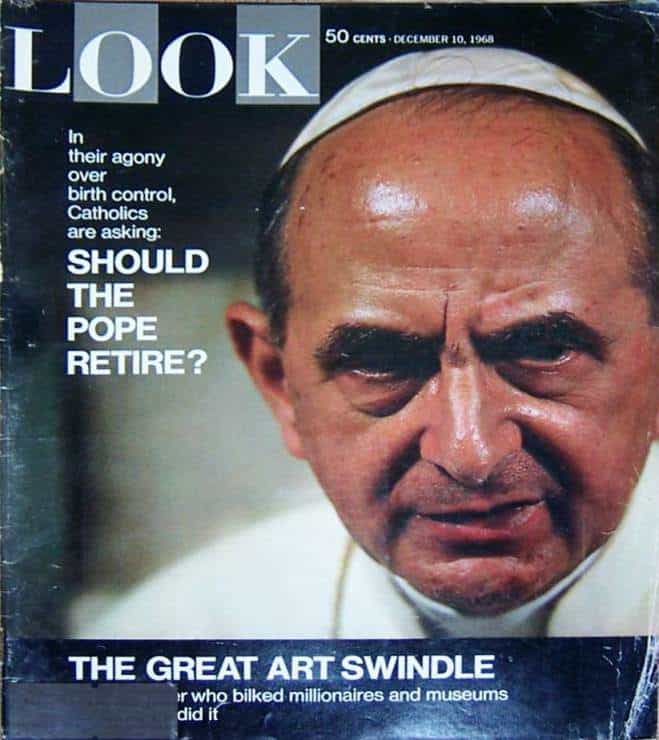
I recently came across the December 10th, 1968, cover of the now defunct Look magazine. Rooted in Des Moines, Iowa of the late 30’s, the magazine began as an unusual format for the time — with an emphasis on photographs over words. In fact, it preferred long captions to articles. It was described by the initial backers of the venture as “an experiment based on the tremendous unfilled demand for extraordinary news and feature pictures”.
From a Minority Approach to the Majority: Images Over Words
What was then a minority approach has in our age of bitstreaming become the majority approach. A flood of questions arises by looking at our media trajectory from the 1930’s. Do not most people glean their news, their sense of the world, and who they are from such impressions? Do not photos make for quicker impression ‘fixes’ than words? Have we become glossy junkies? And if so, how has this ‘part truth’ changed the way we deal with people? Do we not tend to hide behind avatars and misrepresent ourselves? Where is authenticity in the global village, the kind that starts with a simple hello and blossoms into an exchange of persons — so fundamental to friendship and good relationships?
The last three popes have warned us of the danger of skimming information, how such surfing within oneself alters thought process (ideas stay in short-term memory) and how that hinders reflection. Without reflection we can not properly weigh the facts and navigate through the rough seas of sensory information. Without reflection we can not encounter God who lives in the quiet places of the heart and who has given us signs in the very fabric and DNA of the universe. Without reflection we’re no longer really looking, for Him, nor for truth.
Look Magazine’s Pope Paul VI Cover
Take a look at Look. Poor Pope Paul VI. Who needs words. Look at the image. Images don’t lie, do they? The man is sweating and his stern gaze and beady eyes tell us something but it is not at all good. This Pope “looks” like he needs to retire, right? Sound familiar? He certainly doesn’t look like the Vicar of Christ does he? More Nixon than Kennedy in that early TV debate. Nor does he look like a person who should be telling us about sexual intimacy. Pope Paul’s prophetic cautioning to the world about the consequences of sexual liberation and artificial birth control just didn’t have the right look. And look is everything. It’s traction. Right?
In a sense, Look Magazine, has become the majority approach of today’s internet and mass media in general. Look magazine lives, well, everywhere. Look at your iPad. Look at your grocer isles. And again the voice of Marshall McLuhan comes from the corridors of the recent past — the media is the massage. The message is changed by the apparatus of delivery.
When Images Replace Reflection
Back to our grocers, for a momentito — let’s ask them to remove the ‘massaged’ images that line the checkout isles and attempt to feed sugar soda to our ocular appetites and give us a quick fix on life, relationships, and even God. How these modern “Looks” can numb our sense of dignity and our spiritual nature. Even children, reaching up to place items on the conveyor belt, take in the same glossy, image-driven culture long before they have the maturity to weigh it — one more reason to guard what surrounds the young, and what surrounds all of us, with real reflection rather than passive absorption. Look who’s trying to distort our real view of who we are — made in the likeness of a loving Father.
What Look Magazine’s End Still Teaches Us
Look Magazine folded in the early 70’s, outdone by the better Look, that is, T.V. In this growing snowball of amalgamated media, I wonder what new media will take “Look’s Crown” next?
The title to the next article read “The Great Art Swindle”. Ironically, that is what Look magazine is for art strives to capture beauty and truth, the visual poetry of life, that lives beyond what our thimbles of existence can hold.
For a related reflection on making space for that kind of attention, see Thinning Our Distractions.